
How to build dynamic surveys that engage respondents and boost response rates
While traditional surveys offer the same set of questions for all respondents, dynamic surveys adapt in real time based on participants' answers, making them more engaging, personalized, and effective.
Knowing how to design and conduct a dynamic survey enables you to get more accurate data, reduce respondent fatigue, and ultimately make better decisions.
In this article, you'll explore the benefits of dynamic surveys and learn how to build them step by step, with practical examples you can apply right away.
What is a dynamic survey?
A dynamic survey automatically changes questions and their sequence based on the respondent's answers or behavior.
In contrast, in a static survey or traditional survey, all participants see the same questions in the same order.
A dynamic survey is designed so that irrelevant questions are automatically skipped, follow-up questions appear based on previous answers, and question order can be randomized to minimize bias.
Dynamic capabilities make these surveys much more engaging for respondents, enhancing the accuracy and quality of information the researcher gathers.
How to build dynamic surveys
Dynamic surveys use features that make them flexible for the people building and answering them. They can be personalized to each respondent to improve engagement.
Survey logic
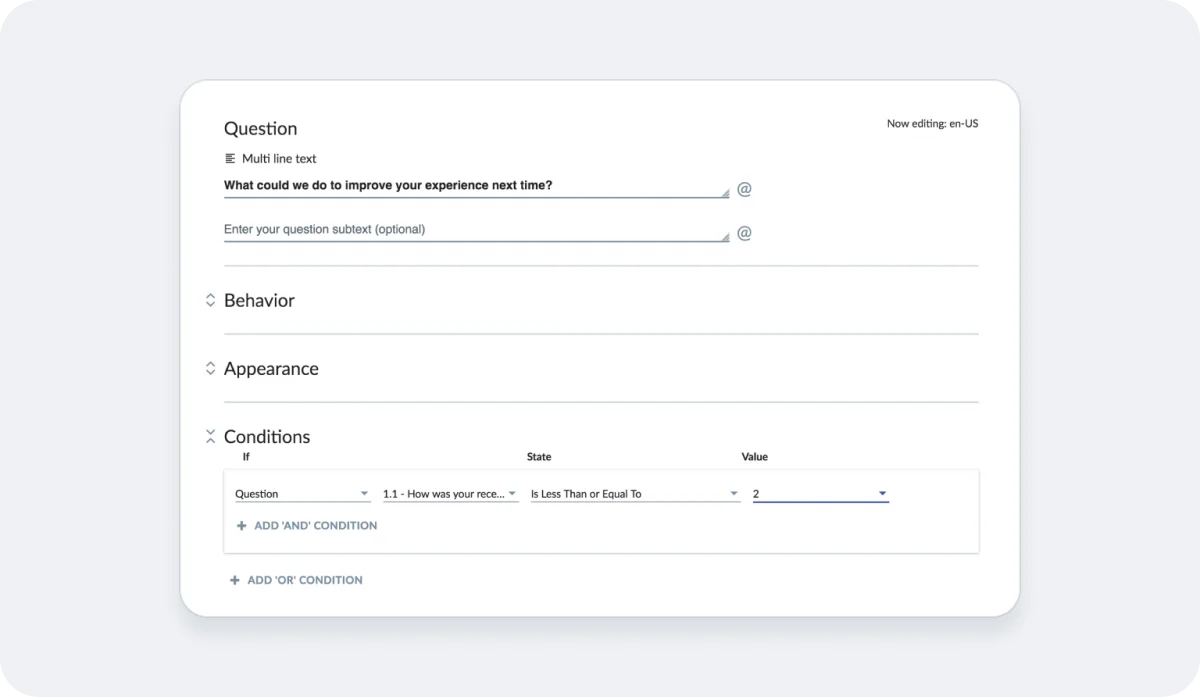
Logic adapts your survey based on the respondent's answers. Logic settings include branching, conditional questions, and skip patterns. For instance, if a participant replies "No" to a question about owning a car, the survey will skip all questions referring to cars. This makes the survey shorter and more relevant, and also prevents the respondent from getting confused, fatigued, or frustrated.
Question randomization
Randomizing questions or answer options reduces the likelihood of bias and helps maintain your respondents' attention. By varying the order of questions or answer options, you reduce the likelihood of formulaic responses and improve the overall reliability of the data.
Multiple languages
By offering surveys in multiple languages, you can reach an even larger audience. Dynamic surveys can automatically detect a respondent's preferred language and localize questions to match it. Dynamic capabilities also allow you to offer respondents the option to select their preferred language at the outset, ensuring convenience and personalization.
Personalization
A dynamic survey may also include personal touches like the name of the respondent, location, or their past responses. Personalization makes surveys feel like they are tailor-made for your audience, increasing engagement and response rates.
In Checkbox, it's easy to create dynamic surveys. For example, you can add conditional logic to any question within the no-code editor.
The benefits of dynamic research
More than just making surveys interactive, a dynamic survey provides measurable advantages to the researcher or data analyst and the respondents.
Reducing respondent fatigue
Dynamic surveys maintain interest by showing only questions that are relevant to each respondent, based on their previous answers. Shorter, more personalized surveys lead to a better overall experience. In contrast, longer surveys are less enjoyable for respondents, according to a recent study on survey experience and nonresponse from Cornell University.
Improving data accuracy
Dynamic surveys help you collect more accurate data with reactive follow-up questions, real-time validations, and the reduction of errors resulting from irrelevant or confusing questions, ensuring that you have solid, actionable insights.
Engaging respondents throughout the survey journey
Interactive features such as branching logic, randomization, and personalized content hold the interest of the respondents from beginning to end. One study on increasing web survey response rates in innovation research found that "personalization increases the odds of responding by as much as 48%".
Supporting wider audiences
Dynamic surveys can reach diverse audiences through multilingual support, personalization, and other advanced features available in enterprise survey software. These software tools allow you to create surveys that are inclusive, culturally sensitive, and accessible to a broader range of respondents. The result is more actionable insights.
Saving time for both respondents and researchers
By reducing irrelevant questions and steps, dynamic surveys save time and effort for both respondents and researchers.
Ready to make your surveys more engaging and insightful? Request a Checkbox demo.
Examples of dynamic survey questions
Let's see the power of a dynamic survey in action. Here are four examples showing how adaptive questions work in these surveys, and why these questions improve the respondents' experience.
1. Conditional follow-up questions
Example: A survey asks, "Do you own a smartphone?"
- If the respondent answers "Yes," they see follow-ups like, "Which brand do you use?" and "How often do you upgrade your phone?"
- If the respondent answers "No," these questions are skipped entirely.
Benefit: This survey logic reduces irrelevant questions and keeps the survey concise.
2. Randomized answer options
Example: A satisfaction survey asks, "Which of these features do you use most?" with five options. The order of options changes for each respondent.
Benefit: This logic helps to minimize response bias and ensure more accurate data on preferences.
3. Personalized survey text
Example: "Hi [Name], thank you for purchasing [Product]. How would you rate your experience?"
Benefit: Personalization increases engagement and makes respondents feel valued.
4. Multi-step branching flow
Example: In a health survey, if a participant reports a dietary restriction at the start, they are directed to specific nutrition questions tailored to their restriction.
Benefit: The survey logic helps to collect detailed, relevant data without overwhelming participants with unrelated questions.
Dynamic surveys can adapt to each respondent, making the experience more interactive, relevant, and efficient while boosting the quality of collected data.
Final thoughts
Dynamic surveys make research more engaging, accurate, and efficient. By using features such as survey logic, question randomization, multiple languages, and personalized content, you can create surveys that are relevant to each participant. This reduces respondent fatigue and improves completion rates and data quality.
- For business, dynamic surveys reveal actionable insights.
- For academic research, they reduce irrelevant data and improve research quality.
- For marketing, they help you collect targeted feedback more efficiently.
Want to create a survey that engages respondents and collects the data that matters most? Building dynamic surveys has never been easier thanks to Checkbox's no-code editor.
This survey tool lets you create complex surveys with a simple drag-and-drop interface – no programming required. You can experiment with branching, randomization, multiple languages, and personalization in minutes. Request a demo to explore everything Checkbox can do.
Dynamic survey FAQs





Contact us
Fill out this form and our team will respond to connect.
If you are a current Checkbox customer in need of support, please email us at support@checkbox.com for assistance.
