
The Kano model: how to prioritize features that actually satisfy customers
Every product team faces the reality that there are more ideas than time, more requests than budget, and more opinions than certainty.
- A stakeholder wants a popular feature.
- Sales wants a quick win.
- Leadership wants differentiation.
- Customers want a better experience, but they do not always want the same thing, and not every feature moves customer satisfaction in the same way.
That is where the Kano model becomes useful. Instead of treating every request as equally important, the framework helps product managers and research teams understand how customers react to different product features. Some are basic expectations. Some are performance features that customers actively compare. Some are unexpected features that create customer delight. Others barely matter at all, and a few can even disappoint customers.
The value is practical. When you use the Kano model, you stop relying on gut instinct alone and start mapping consumer responses to a clearer prioritization logic. You can see which ideas are must-be features, which ones increase customer satisfaction in a more linear way, and which nice-to-haves are actually worth the implementation investment. That makes it easier to build a product roadmap that reflects real customer needs instead of internal guesswork.
In this guide, you'll learn what the Kano model is, how the five feature categories work, how customer expectations change over time, how the Kano questionnaire works, how to run a practical Kano analysis, and how a Kano model template can help you get started faster. To make those later steps useful, it helps to begin with the foundation: what the Kano model actually is.
What is the Kano model?
At its core, the Kano model is a product prioritization framework that helps teams understand the non-linear relationship between product characteristics and customer satisfaction. The model was developed by Dr. Noriaki Kano and colleagues in 1984 in the paper Attractive Quality and Must-Be Quality. Kano later became professor emeritus at Tokyo University of Science, and his work remains one of the best-known contributions to quality management and customer satisfaction research.
The core insight is simple, but powerful: more functionality does not always make customers happier in a straight line.
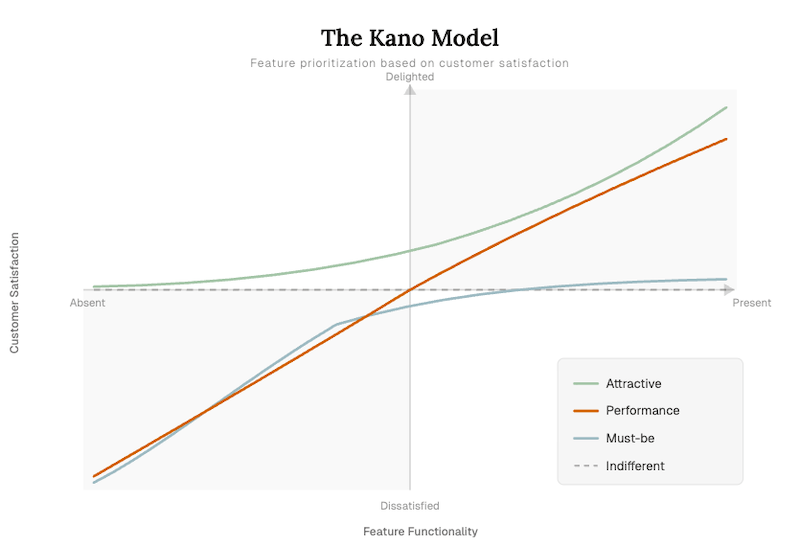
Some features are basic necessity items. Customers expect them, so their absence causes frustration, but their presence does not create excitement. Other features behave like one-dimensional attributes, where the more you improve them, the more satisfaction you get in return. Then there are attractive quality features, which can delight customers in a way that feels out of proportion to the effort behind them.
That is why the Kano model helps product teams prioritize features based on potential customer reactions rather than internal assumptions.
In practice, it does that through a structured survey. Customers respond to paired questions about a given feature, and those customer responses are then mapped through a standard Kano evaluation table. The result is a data-backed view of which features fall into which Kano categories, giving teams a more defensible basis for product decisions.
Once that principle is clear, the next step is understanding the five categories themselves.
The five Kano model feature categories
Now it's easier to see how that logic plays out in the five feature categories that shape a Kano analysis. Most summaries focus on three headline categories, but the full framework sorts features based on customer preferences across five groups.
Must-be features
Must-be features are the basics. These are the things customers expect to be there without needing to ask. Their presence does not make customers especially happy because they see them as the price of entry. Their absence, however, creates immediate dissatisfaction.
A working set of brakes in a car is a classic example. So is hot water in a hotel room. Nobody books a hotel because the room has hot water. They book it assuming that hot water is a basic need that must be met. When it's missing, though, the experience falls apart quickly. That is why must-be quality matters so much: basic features rarely win you praise, but failing on them can seriously damage trust.
Performance features
Performance features are the ones customers know they want and actively compare across products. In the original language of the model, these are one-dimensional attributes. Satisfaction rises as performance rises, and dissatisfaction rises when performance falls short.
Internet speed is a useful example. Faster service usually makes customers happier. Slower service does the opposite. Cloud storage capacity works in a similar way. If one provider offers more space, clearer limits, and better usability, customers often see that as a direct improvement.
These are the areas where implementation investment tends to have a more predictable payoff. The more effectively you improve the feature, the more likely you are to increase customer satisfaction.
Attractive features
Attractive features are the unexpected features that create a positive emotional response when present, even though customers would not have demanded them beforehand. These are often called delighters, and they sit at the heart of customer delight in the Kano model.
The important nuance is that attractive quality can range from mild pleasantness to genuine excitement. A small piece of thoughtful automation might save time and feel impressive. A beautifully designed shortcut might make a product feel easier and more modern. A well-timed personalization feature might delight customers because it solves a problem before they articulate it. If those features are absent, most customers won't complain because they never treated them as basic expectations in the first place.
Indifferent features
Indifferent features are the ones customers do not meaningfully care about. Their presence or absence makes little difference to how customers feel.
That may sound harmless, but identifying indifferent features is one of the most useful parts of Kano analysis.
Why? Because product teams often spend valuable time building things that are technically interesting but commercially irrelevant. If a feature doesn't satisfy customers, doesn't improve adoption, and doesn't meaningfully shape consumer responses, it's probably not worth the effort. Under tight deadlines, spotting indifferent features can save budget, reduce noise in the roadmap, and protect teams from shipping work that changes nothing.
Reverse features
Reverse features are a reminder that not every feature is universally wanted. In some cases, adding a feature can actively worsen the experience for part of your audience. Instead of making customers happy, it feels off-putting.
That can happen when a product becomes too complex, too intrusive, or too automated for the people using it. A heavy-handed onboarding flow might feel helpful to one group and frustrating to another. A forced social feature might appeal to some users and annoy others. Reverse features matter because they show that customer needs are not always aligned, and that popular features are not automatically good features.
Taken together, these Kano categories give you a more nuanced view of quality than a simple high-priority versus low-priority list. They also set up an important truth: categories are not permanent. What delights customers today can become a basic expectation tomorrow.
How features change over time
The five categories are useful, but they are not fixed.
One of the most important ideas in the Kano model is that customer expectations change. Attractive features often decay over time. What starts as a pleasant surprise can become a performance feature once customers notice it, and later turn into a must-be feature once competitors adopt it, and the market resets its standards.
The first iPhone is a widely cited way to think about this shift. When Apple introduced the original iPhone in 2007, it described a new multi-touch interface controlled by tapping, flicking, and pinching with your fingers. At the time, that kind of fluid touchscreen interaction felt remarkable. Later, it stopped being remarkable and started being normal. That is exactly how attractive features move through the model as markets mature.
For product managers, the lesson is clear. Kano analysis should not be treated as a one-off workshop you run once and forget. It works best as continuous analysis.
If customer expectations change, your categorization needs to change with them. The feature that once differentiated your product may now be a basic expectation, and the feature you dismissed last year may now matter much more. That makes the questionnaire itself critical, because it is the mechanism that lets you measure those shifts instead of guessing at them.
How the Kano questionnaire works
The Kano model is not just a theory about how customers react, it's a research method. To determine where features fall, you use a structured Kano questionnaire built around paired questions for each proposed feature.
For every feature, respondents answer two prompts. The first is the functional question: how would you feel if the feature were present? The second is the dysfunctional question: how would you feel if the feature were absent? This functional and dysfunctional structure is what allows the model to capture the two dimensions behind the framework instead of relying on a single rating.
Each question uses the same five emotional responses: I like it, I expect it, I am neutral, I can tolerate it, and I dislike it.
When you combine the answers to the functional and dysfunctional questions, you can use the standard evaluation table to classify the response as must-be, performance, attractive, indifferent, reverse, or questionable. In other words, the model works by mapping consumer responses rather than asking people to label feature categories directly.
That distinction matters. Customers are usually very good at expressing how they feel, but not always great at telling you which feature should be built next. The Kano questionnaire turns those emotional response patterns into something product teams can act on
It's also where a survey platform becomes practical.
Checkbox's no-code survey maker supports custom surveys and advanced logic, its template library gives teams a reusable starting point, and its analytics and reporting tools help teams organize and share what they learn. For organizations that need tighter control, Checkbox also offers security and permissions features built around data protection.
Once you understand how the questionnaire produces Kano results, the workflow for running an analysis becomes much more straightforward.
How to run a Kano analysis: step by step
Now that the questionnaire format is clear, here is how to run a Kano analysis in a way that is practical for real product teams.
1. Choose a focused list of features
Start with a manageable shortlist. If you test too many product features at once, respondents get fatigued, and the data quality drops. Focus on the features most likely to affect customer satisfaction, your next release, or an upcoming product roadmap decision.
2. Write clear functional and dysfunctional question pairs
Each feature should become two questions: one asking about the feature being present, one asking about it being absent. Keep the wording concrete.
Avoid vague language and double-barreled question phrasing that forces respondents to evaluate more than one idea at a time.
Clean wording is essential because confusing questions distort customer responses before the analysis even begins.
3. Send the survey to the right respondents
Kano analysis only works if the audience matches the decision you are making.
Existing customers may react differently from prospects. Power users may react differently from first-time users. If your product serves multiple segments, consider running the analysis by group so you can spot where reverse features or different feature categories appear.
4. Categorize each answer using the standard Kano evaluation table
After the responses come in, combine each person's functional and dysfunctional answers for each feature and assign the corresponding category from the standard Kano evaluation table.
Next, aggregate the results. Most teams use a simple discrete analysis first: whichever category appears most often becomes the feature's primary classification.
5. Plot the results on the Kano graph and prioritize accordingly
Once features are categorized, you can visualize them on a Kano graph.
The vertical axis represents satisfaction, from total dissatisfaction to total satisfaction. The horizontal axis represents functionality or achievement, from not delivered to well delivered. This visualization helps you see which must-be features need coverage, which performance features deserve optimization, and which attractive features could create differentiation.
That systematic, but not overly complex, process is core to using the Kano model successfully. More importantly, it gives product teams a better way to prioritize features when resources are limited.
A Kano model template
A good Kano model template gives you structure before the research starts. Instead of rebuilding the same survey logic every round, you begin with a repeatable format that keeps your questions, response options, and analysis consistent.
A typical Kano model template includes the feature list you want to evaluate:
- The paired functional and dysfunctional questions for each feature
- The standard five response options
- The evaluation table used to classify answers
- A simple results summary sheet or dashboard
In other words, it covers both the survey itself and the framework for interpreting Kano results.
That consistency matters more than it first appears. When the structure stays the same, it becomes easier to compare one research wave to the next. You can see whether customer expectations change, whether previously attractive features have become basic expectations, and whether indifferent features are still soaking up attention they do not deserve – especially useful when you treat Kano as continuous analysis rather than a one-time exercise.
The best starting point is usually a survey template rather than a blank document. Checkbox's survey template library gives teams a ready-made foundation, while its no-code survey builder makes it easier to create the paired question format and response logic without heavy setup.
Once responses are collected, Checkbox's analytics and reporting tools can help turn raw customer responses into something more useful for decision-making.
A template will not decide your roadmap for you. What it does is remove unnecessary friction, keep your method consistent, and make it much easier to run another round when priorities shift. With that structure in place, the final step is turning the insight into action.
Final thoughts
The Kano model helps product managers, researchers, and broader product teams make smarter decisions about what to build next. It does that by grounding prioritization in how customers actually feel, not just in what internal stakeholders assume.
When you understand the difference between must-be features, performance features, attractive features, indifferent features, and reverse features, it becomes much easier to focus effort where it will matter most.
That makes the framework especially useful when you are balancing limited resources, competing requests, and a product roadmap that cannot hold everything. You're no longer just ranking features based on volume of requests; you're prioritizing them based on likely impact on customer satisfaction.
If you are ready to start, Checkbox is a strong place to do it.
Checkbox gives teams the tools to build and distribute Kano questionnaires, manage survey logic, collect responses securely, and turn feedback into clearer prioritization decisions through analytics and reporting. For research-driven teams that need flexibility and control, it's a practical way to move from customer feedback to a more confident roadmap. Request a Checkbox demo today.
Kano model FAQs




Contact us
Fill out this form and our team will respond to connect.
If you are a current Checkbox customer in need of support, please email us at support@checkbox.com for assistance.
