
59 employee engagement survey questions with practical examples by category
Culture is a vital part of any business, and when it’s not right, you can tell. Turnover starts creeping up, managers hear the same frustrations in one-on-ones, and teams that used to move quickly begin to lose momentum.
The challenge is not spotting that engagement has slipped. It’s understanding exactly why employees feel disconnected, where the pressure points are, and what to fix first. That’s why the right employee engagement survey questions matter so much: they turn vague concerns into actionable employee survey data you can use to improve the employee experience.
Gallup’s 2026 State of the Global Workplace report found that global employee engagement fell to 20% in 2025, its lowest level since 2020. The same report estimates that low engagement cost the world economy $10 trillion in lost productivity last year. That is the scale of the problem HR teams, people ops leads, and senior leaders are dealing with when they try to improve retention, performance, and the overall employee experience.
The good news is that improving employee engagement does not start with a grand culture transformation. It starts with asking better questions.
The quality of your employee engagement survey questions shapes the quality of your survey data, and the quality of your survey data shapes the action you can take.
This guide is built to be practical.
You’ll find employee engagement survey questions examples across the major drivers of engagement, guidance on which survey question formats to use, open-ended employee engagement survey questions you can tailor to your own workforce, and advice on how to interpret employee engagement survey results without overcomplicating the survey process.
Why employee engagement matters
Before you choose a question format or build a survey platform workflow, it helps to be clear on why employee engagement is worth measuring in the first place.
Gallup’s research links high engagement to stronger business outcomes, not just better morale. For example, teams with low engagement typically endure turnover rates that are 18% to 43% higher than highly engaged teams.
Employee engagement surveys help you understand the core reasons behind poor business performance and high employee turnover. Without a structured engagement survey, you are left with guesswork, one-off complaints, voluntary attrition and leadership assumptions.
With the right employee survey questions, you can measure employee sentiment over time, spot patterns early, identify the key factors influencing employee satisfaction, and understand what engaged employees feel that disengaged employees do not.
Types of employee engagement survey questions
Once you know why engagement data matters, the next question is how to collect it in a way that produces actionable data rather than noise.
- Likert scale questions – Likert scales usually use a five- or seven-point scale from “strongly disagree” to “strongly agree.” They are the backbone of most employee engagement surveys because they make it easy to compare scores over time and across teams.
- Rating scale questions – These ask employees to rate something on a numeric scale, such as 1 to 10. They are useful when you want to measure intensity, satisfaction, or confidence.
- Yes/no questions – These are fast and clear, but they work best for factual or binary issues rather than nuanced employee perceptions.
- Open-ended questions – These let employees answer in their own words. They add qualitative data and context that closed-ended questions cannot capture, which is why they are often the source of the most valuable insights. You should also mix question types and keep employee satisfaction surveys brief and focused so responses stay thoughtful rather than rushed.
Most well-designed employee engagement surveys combine these formats. Likert and rating scales help you measure trends, while open-ended items help you understand why employees feel the way they do. Overall sentiment alone will not tell you which parts of the employee experience actually need work.
Best employee engagement survey questions by category
Engagement is multi-dimensional. A single overall score might tell you whether employees feel connected, but it won’t tell you whether leadership, workload, role clarity, recognition, or team dynamics are driving that score. That is why the best employee engagement survey questions break engagement into specific, measurable themes.
For most of the below questions, you can ask “how much do you agree with the following statement?” and use a rating scale or a Likert scale from “Completely disagree” to “Completely agree.”
Management and leadership questions
Gallup says managers account for 70% of the variance in team engagement, making management questions one of the most important categories in any engagement survey.
- My direct manager gives me useful feedback that helps me improve
- My manager cares about me as a person
- My manager sets clear expectations for my day-to-day work
- I feel comfortable raising concerns with my manager
- Senior leadership communicates the company’s direction clearly
- I trust senior leaders to make decisions in the best interests of the organization
- Leadership follows through on the commitments it makes to employees
Role clarity and growth questions
These questions measure whether employees understand what success looks like in their role and whether they can see room for career development.
- I understand what is expected of me at work
- I have clear goals for my role
- I have the tools and resources I need to do my job well
- I know how my work contributes to the organization’s success
- I have had opportunities to learn new skills in the last 12 months
- I can see a clear path for professional growth here
- I receive enough support to develop my career
Recognition and reward questions
Recognition shapes whether employees feel valued, and strengthens retention as well as connection to the organization.
- I have received recognition for good work in the recent past
- My contributions are valued by my team
- Strong performance is rewarded fairly in this organization
- I feel appreciated for the work I do
- Recognition here feels meaningful, not performative
- I understand how high performance is acknowledged in this company
- People who do great work are noticed by leadership
Teamwork and collaboration questions
This category looks at the quality of peer relationships, collaboration, and whether employees feel connected to the people around them.
- My team works well together
- Colleagues on my team support one another
- I feel comfortable speaking up with teammates
- Different teams across the organization collaborate effectively
- I have the information I need from other teams to do my job well
- I feel a sense of belonging on my team
- Conflict is handled constructively where I work
Company culture and values questions
These questions test whether your workplace culture exists in practice, not just in slide decks and employer branding.
- The company lives by its stated values
- I am proud to work for this organization
- I would recommend this company as a great place to work
- The culture here supports high-quality work
- The work environment encourages honesty and respect
- I believe leaders model the behaviors the company expects from employees
- Company culture positively affects my motivation to do my best work
Well-being and workload questions
Engagement drops when people feel stretched too thin, unsupported, or unable to maintain a work-life balance. Burnout risk is also something organizations should actively monitor.
- My workload is manageable most of the time
- I can do high-quality work without regularly working beyond my normal hours
- I feel able to switch off outside work hours
- The company supports my mental health and well-being
- I have a healthy balance between work and personal life
- Flexible work arrangements support me in doing my best work
- I have the proper tools and support to manage pressure in my role
Inclusion and belonging questions
Inclusion and belonging questions measure whether employees feel respected, heard, and safe enough to contribute fully.
- I can speak up without fear of negative consequences
- Everyone here is treated fairly, regardless of background
- My perspective is genuinely valued in team decisions
- I feel respected by the people I work with
- I can be myself at work
- People from different backgrounds have equal opportunities to succeed here
- I feel included in the day-to-day culture of my team
Closed questions like these give you structure and consistency. The next layer is open-text questions, which is often where the most revealing employee feedback shows up.
Open-ended employee engagement survey questions
Closed questions tell you where the problem is. Open-ended questions tell you why it exists.
That’s what makes open-ended employee engagement survey questions so valuable. They surface employee sentiment in employees’ own words, reveal language and context you would never get from a rating scale alone, and often point to issues the survey designer didn’t think to ask about directly.
It’s always good to mix quantitative and qualitative question types while keeping the survey focused and brief.
Used well, open-ended questions can uncover critical insights about workplace culture, direct managers, team dynamics, career development, or the broader work environment. Used badly, they create a pile of comments no one reads. A good rule is to include two to four open-ended questions near the end of the survey so you capture honest feedback without creating survey fatigue.
Here are some strong open-ended employee engagement survey questions examples:
- What is one thing we could change that would most improve your experience at work?
- What is the company doing well that it should continue doing?
- What would make you feel more supported in your role?
- What gets in the way of you doing your best work here?
- What could your manager do differently to help you succeed?
- What helps you feel engaged and connected at work?
- Where do you see the biggest gap between our company values and the day-to-day employee experience?
- What would improve collaboration between your team and other teams?
- What would make your workload feel more sustainable?
- Is there anything else you would like leadership to know?
The value of these questions depends on trust. Surveys without visible follow-through can backfire, and confidential survey design is important because people are far more likely to share candid feedback when they believe responses cannot be traced back to them.
Once those answers come in, the next challenge is knowing what good actually looks like – especially considering how low employee engagement is worldwide.
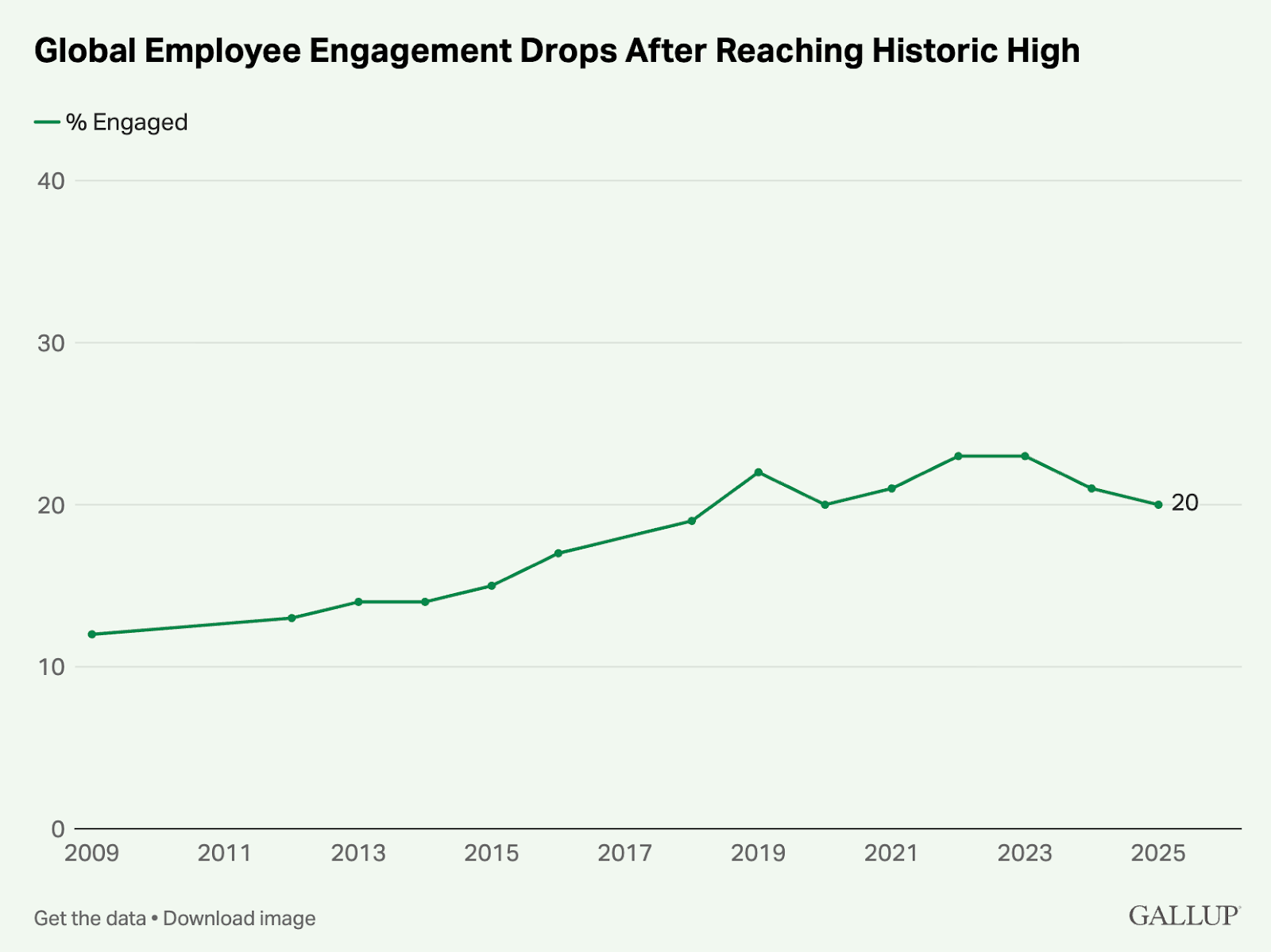
Employee engagement survey questions and answers: what good looks like
Interpreting employee engagement survey questions and answers is where many teams get stuck. They collect survey results, export a dashboard, and then spend weeks debating what a 3.8 really means.
Start with context. Benchmarks vary by industry, geography, survey model, and workforce mix. Still, a useful external reference point is that top-performing organizations average around 70% engaged employees, far above typical norms – that should not become a rigid target for every company, but it is a helpful reminder that strong engagement scores look meaningfully different from average ones.
At the category level, consistent Likert scores of 4 to 5 on a five-point scale usually signal strength. Scores clustering around 2 to 3 indicate friction, uncertainty, or inconsistency.
A single low item doesn’t always mean a crisis. A pattern of low scores around leadership communication, workload, and recognition usually does.
For open-ended responses, look for three things:
- Recurring themes – The same issue appearing across departments is often more important than the loudest individual comment
- Specific language – Repeated words like “unclear,” “overloaded,” “ignored,” or “valued” are often more useful than averages alone
- Balance of feedback – A healthy survey response set usually includes both positive feedback and improvement-focused feedback, not just one or the other
The most useful engagement data combines both views. Quantitative scores tell you where to focus. Qualitative data tells you what employees mean, what they expect, and what action will feel credible from their perspective.
That only works, though, if the questions themselves are written well.
How to write effective survey questions for employee engagement
Once you know what categories to cover, question design becomes the difference between useful survey data and muddy results.
Use this checklist when writing survey questions for employee engagement:
- Ask about one thing at a time
Avoid double-barreled questions like, “I’m satisfied with my manager and my career growth.” If an employee agrees with one part and disagrees with the other, the answer becomes meaningless.
- Use neutral language
Good employee survey questions don’t push respondents toward a positive or negative response. The goal is to measure employee perceptions, not to defend the company.
- Keep the survey short enough to finish in 10 to 15 minutes
Checkbox’s guidance is clear here: shorter surveys tend to be more effective, and focused questions make analysis easier. Use our employee engagement survey template to get started
- Make every question actionable
Ask only about areas where leaders, managers, or HR can realistically make changes. Effective employee surveys focus on factors that link to performance and can lead to clear next steps.
- Stay consistent across survey cycles
If you rewrite half the survey every quarter, trend data becomes much less useful. Keep core items stable so you can measure employee engagement over time, then add a small number of pulse surveys or rotating questions as needed.
- Protect anonymity and confidentiality.
Employees are more likely to give honest feedback when they trust the process. Anonymous surveys make it easier for employees to say what they truly think.
- Plan the follow-up before you launch the survey
Asking for feedback without acting on it can decrease engagement and increase turnover. In other words, survey design is only half the job.
What to do with employee engagement survey results
The most common failure in employee engagement surveys is not poor question design; it’s poor follow-through.
Surveys are most effective when they are followed by impactful action, and they can backfire when leaders collect feedback and do nothing with it. When people see no action from previous feedback, trust erodes and participation drops.
A practical post-survey process looks like this:
- Share results transparently
Do not keep survey results locked in leadership meetings. Share the themes, strengths, and problem areas with the wider organization.
- Prioritize two or three issues
Trying to fix everything at once usually means nothing gets fixed properly. Focus on the biggest drivers of employee engagement outcomes first.
- Involve employees in solutions
The people closest to the work often know exactly what is causing friction. Follow-up conversations, manager-led discussions, and employee working groups can turn survey data into better solutions.
- Set a timeline and communicate it
Tell employees what will happen next, who owns each action, and when they should expect an update.
- Measure again
The next survey cycle should test whether the needle moved, as that’s how employee engagement surveys become part of continuous improvement, instead of a once-a-year reporting ritual.
You should also consider a purpose-built survey platform.
Checkbox’s employee feedback solution provides branded survey experiences, dashboards, and out-of-the-box analytics designed to make feedback analysis and action planning easier. Our employee feedback tools offer you a way to gather, analyze, and act on employee input in real time rather than leaving results stuck in spreadsheets.
Final thoughts
The right employee engagement survey questions do not improve engagement on their own. The real cycle is simpler and more demanding than that: ask, analyze, act, and repeat.
Organizations that treat engagement surveys as an ongoing conversation get far more value from them than organizations that treat them as an annual checkbox exercise. They build better visibility into employee sentiment, spot problems earlier, and create a stronger link between employee feedback and business action.
Checkbox makes that process easier by giving teams a practical way to build surveys, distribute them, collect both quantitative and qualitative data, and turn survey results into dashboards and actionable insights. For teams that want to improve employee engagement without needing a dedicated research function, request a Checkbox demo today.
Employee engagement survey questions FAQs




Contact us
Fill out this form and our team will respond to connect.
If you are a current Checkbox customer in need of support, please email us at support@checkbox.com for assistance.
