
Pulse survey basics: how to run one that actually gets results
Employee sentiment can shift fast – a reorg lands badly, a new manager joins, workload spikes, or a change in policy quietly chips away at employee morale.
If you only run annual surveys, you often find out too late. By the time the data comes in, the problem has already spread, and people have already made decisions about whether they're staying.
A pulse survey gives you a lighter, more frequent way to gather feedback. You get real-time insights on what's working, what's getting in the way, and what needs attention now – not next quarter.
In this guide, you'll learn what a pulse survey is, how it compares to traditional surveys, why employee pulse surveys provide such valuable insights, and how to design a survey process that turns survey feedback into meaningful change. First, let's start with the basics.
What is a pulse survey?
A pulse survey is a short, frequent survey designed to check in on how people are feeling and performing over time. It's usually an employee survey, but the same idea can be used for customer satisfaction surveys when you want quick decision-making after key moments.
The name comes from taking the "pulse" of your workforce – a quick read on organizational health without the heavy lift of long, once-a-year questionnaires.
Most pulse surveys follow a simple format:
- Length – Only a few questions, typically 5–15 pulse survey questions
- Cadence – Weekly, fortnightly, or monthly, depending on survey frequency and your ability to follow up
- Focus – One theme per survey, such as workload, manager support, job satisfaction, or work-life balance
- Consistency – The same core questions repeat, so you can track trends and benchmark over time
Because pulse surveys are tracked frequently, they're built for continuous improvement. You're not aiming for a perfect, definitive answer. You're aiming for timely feedback and actionable insights you can act on while the context is still fresh.
Pulse surveys vs. annual engagement surveys
Now that you know what a pulse survey is, it's easier to see why it's often compared to annual surveys. They look similar on the surface, but they solve different problems.
An annual engagement survey is a deep, broad snapshot. It typically covers the entire organization and spans multiple themes: leadership, culture, career development, pay and benefits, wellbeing, professional development, and more.
A pulse survey is a faster check-in. It's shorter, more targeted, and designed to catch movement – not just measure a moment in time.
Here's a practical comparison:
Pulse surveys don't replace traditional surveys; they complement them.
Many teams run annual employee opinion surveys to get deeper insights and influence strategy, then use pulse surveys to track progress, measure the impact of interventions, and capture immediate feedback when something shifts.
When you treat them as a pair, the real payoff shows up fast – which brings us to the benefits.
The benefits of running pulse surveys
If annual surveys tell you where you are, pulse surveys provide the compass that keeps you moving in the right direction. The format is simple, but the impact can be significant when you use pulse surveys well.
Higher response rates due to shorter format
Short surveys are easier to finish. People can complete a pulse survey in a few minutes between meetings, helping keep response rates steady over time.
That consistency matters. If response rates drop, your data collected becomes less representative, and it gets harder to trust what's happening across teams.
Real-time visibility into morale, engagement, and wellbeing
Pulse surveys provide immediate insights into employee perceptions. You can spot dips in engagement, cultural trends, spikes in workload stress, or changes in manager relationships while they're still small enough to address.
That's especially useful during periods of change, such as during onboarding waves, restructures, peak season, or policy updates.
The ability to spot problems early, before they escalate
Frequent surveys make it easier to identify issues early. A small pattern, like a slow decline in employees saying they have what they need to do my job, can become a retention problem if ignored.
Pulse surveys help you see those patterns before they turn into employee turnover.
A stronger feedback culture and sense of employee voice
When people see that their input leads to changes and follow-ups, they're more likely to provide feedback again. According to one report, 90% of workers would be more likely to stay at a company that takes and acts on feedback. Over time, pulse surveys can strengthen company culture by normalizing honest feedback and turning it into action.
That's where employee pulse surveys provide real value – not just data, but trust.
Easier benchmarking over time
Because questions repeat, you can track trends cleanly. You're not comparing apples to oranges each quarter.
A small, stable question set gives you actionable data you can use for benchmarking, whether that's by team, region, tenure, or target audience.
Those benefits are the "why," next comes the "how" – designing a pulse survey that people will actually complete, and leaders will actually use.
How to create a pulse survey
To get the real benefits, you have to be intentional in your design. A pulse survey should feel easy for employees and useful for decision makers.
Here's a step-by-step approach that keeps survey creation practical and avoids survey fatigue.
1. Define the goal before you write questions
Pick one clear outcome. You might be tracking employee engagement after a change, checking job satisfaction in a specific team, or understanding workload pressure across a function. A pulse survey without a goal becomes noise.
2. Choose the theme and target audience
Decide whether you're surveying the entire organization or a specific group. A company-wide pulse survey works well for broad signals. A targeted pulse survey works well for critical matters like burnout hotspots or manager support in a single department.
3. Pick question types that match the insight you need
Mix quantitative and qualitative where it adds value:
- Agreement scales, also known as Likert scales, such as "Strongly disagree" to "Strongly agree," are great for tracking employee sentiment over time
- Rating scales help you measure intensity, like confidence in leadership or clarity of priorities
- Open-ended prompts give context, especially when numbers move unexpectedly
Use quantitative questions to get the pulse, and qualitative questions to get the insights.
4. Keep it short and focused
A pulse survey works best when every question earns its place. Remove anything that isn't tied to your goal.
5. Set your survey frequency and commit to it
Consistency reduces friction. People know what to expect, and you get cleaner trend data.
6. Choose pulse survey software that makes following up easy
Look for tools that support automated sending, segmentation, anonymity controls, and reporting features that make survey results easy to share. Checkbox supports employee feedback programs with analytics and reporting designed for real-time insights. Read more about our employee feedback solution.
7. Communicate clearly before you send
Tell employees:
- Why you're running it
- How long it'll take
- Whether it's anonymous
- What will happen after the results come in
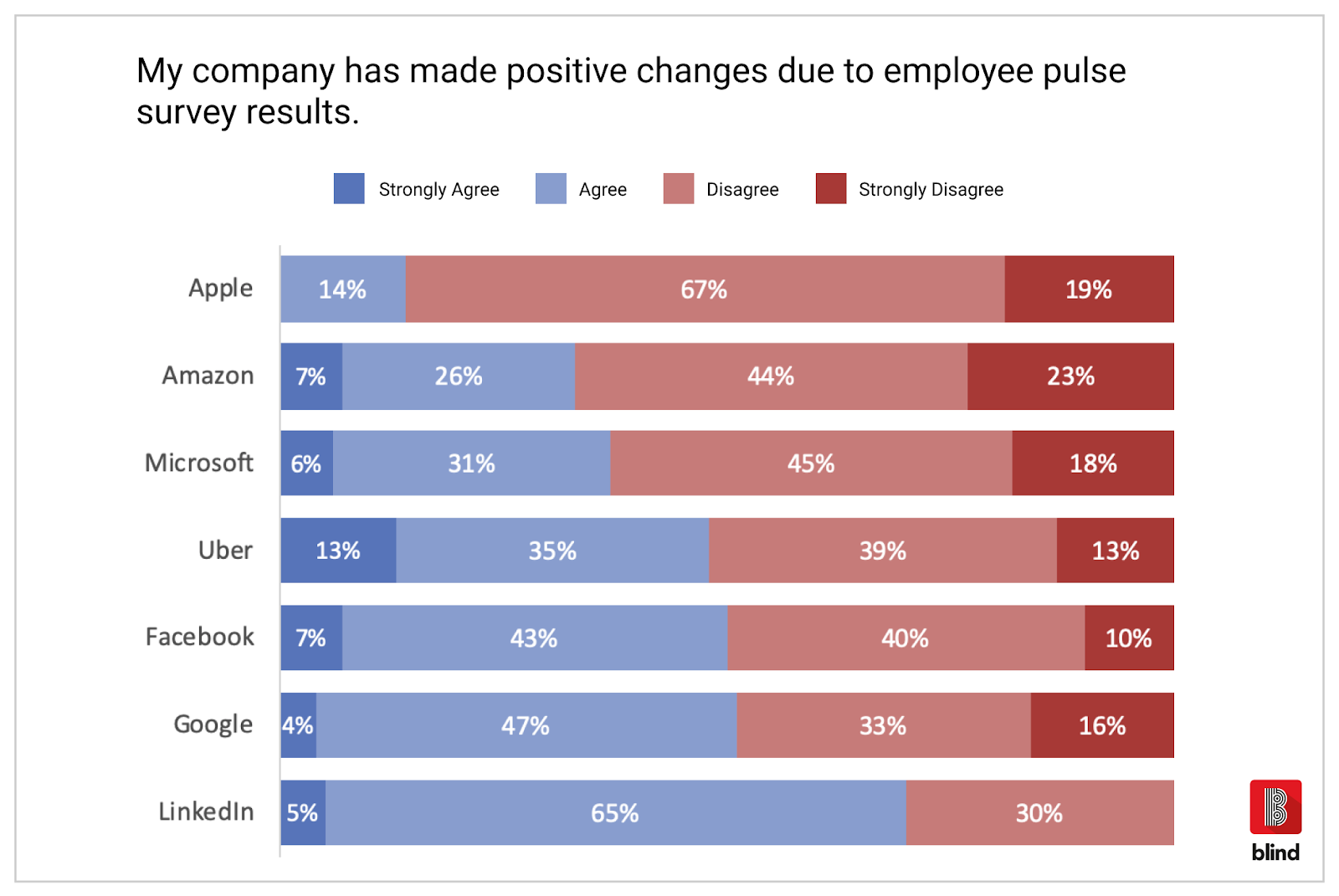
That last point matters. People will make time for surveys when they trust the outcome will be actionable feedback, not a black hole. And remember: Pulse surveys can be challenging, but the most important thing is that you act on the data. Even the biggest companies in the world don’t do this as well as they could, according to research from Blind.
With the build process in place, two design choices tend to make or break results: question count and cadence.
How many questions should a pulse survey have?
Most teams land in the 5–15 question range.
Fewer questions boost completion rate, but reduce depth. More questions add detail, but can chip away at response rates over time.
A practical way to balance it looks like this:
- 3–10 core questions that stay consistent for benchmarking
- 1 open-ended question to capture context
- 0–3 rotating questions when you need specific insights for a short period
Consistency matters more than novelty. When questions change every time, it becomes harder to track trends, and employees start to feel like the surveys are directionless.
How often should you send a pulse survey?
Survey frequency should match your capacity to act on results. If the team can't respond to what they're hearing, running surveys more frequently can backfire.
Common cadences include:
- Daily – Suitable for small-team environments, with 1–3 questions on how they're feeling and their priorities for the day
- Weekly – Best for fast-moving environments or short-term initiatives, like onboarding, change programs, or high-intensity projects
- Fortnightly – A strong default for many teams, giving enough time for movement without overwhelming people
- Monthly – Good for larger organizations, or when analysis and follow-ups take longer
Survey fatigue usually comes from two things: too many surveys or too little visible action. If you're not ready to do something with the data, slow down the cadence.
Once you've decided on the structure and timing, the next step is filling your employee pulse survey with questions that produce actionable insights.
Employee pulse survey questions to include
A strong question set covers what you need, and avoids what you don't. Keep the language simple, and write questions the way people actually speak.
Below are example pulse survey questions grouped by theme. Each theme can be its own pulse survey, or you can blend a few core questions across themes when you need a wider read.
For the majority of them, you'll provide respondents with a Likert scale, from "Strongly disagree" to "Strongly agree," so they can answer. You could also provide a numerical rating scale, with "1" the most negative and "10" the most positive.
Employee engagement and purpose
- I understand how my work contributes to team or company goals.
- I feel motivated to do my best work right now.
- I would recommend this organization as a great place to work.
Manager support and relationships
- My manager gives me the support I need to succeed.
- I get useful feedback from my manager on a regular basis.
- When I raise a concern, I trust it will be taken seriously.
Workload and work-life balance
- My workload feels manageable this week.
- I have enough time to do quality work.
- I can maintain a healthy work-life balance in my current role.
Wellbeing and psychological safety
- I feel comfortable speaking up when something isn't working.
- I feel supported when work feels stressful.
- I can take breaks and recover when needed.
Recognition and growth
- My work is recognized in a way that feels meaningful.
- I have opportunities for professional growth in my role.
- I can see a clear path for career development here.
One open-ended question for context
- What's one thing we should start, stop, or continue to improve your experience?
Tweak this question based on the closed-ended question before it. You could even use survey logic, so open-ended questions only appear when certain answers are selected.
A good mix gives you numbers to track and words to interpret them. That combination helps you move from survey results to actionable feedback.
Asking the right questions is only half the job, though. The real test is what happens next.
How to act on pulse survey results
Pulse surveys provide value when employees can see the impact. If you don't follow up on results with action, surveys become performative, and response rates drop.
A simple action loop keeps things moving.
Share results quickly and clearly
Aim to share high-level findings within days, not weeks. People don't need a 30-slide deck. They need to know:
- What you heard
- What stands out
- What happens next
When results are sensitive, share trends at the team or organization level and protect anonymity.
Identify themes and prioritize actions
Look for patterns across segments. Averages can hide real problems.
For example, a company-wide "7/10" on workload might mask a team that's consistently at "3/10." Segmenting results by function, location, or tenure often reveals where to focus first.
Assign ownership and timelines
Actionable feedback needs an owner. If a theme is "unclear priorities," decide who will fix it, what "fixed" looks like, and when people can expect an update.
Close the loop with employees
To close the loop, you need to tell employees what changed because of their input.
Even when you can't act immediately, say so. Transparency builds trust, and trust drives honest feedback.
If you want pulse surveys to drive continuous improvement, acting on results has to become a habit. The next section pulls that habit into a set of best practices you can apply across every survey.

Pulse survey best practices
Good pulse surveys feel light for employees and powerful for leaders. These best practices help you keep the quality high without turning the process into a project.
- Keep surveys anonymous where possible – Anonymity increases the likelihood of honest feedback, especially on manager relationships, wellbeing, and company culture.
- Tie each pulse survey to a clear goal – Avoid running surveys out of habit. If a question won't lead to action, it probably shouldn't be there.
- Use consistent questions to benchmark over time – Trend tracking is one of the biggest advantages of conducting pulse surveys. Keep the core set stable, and rotate only when you have a clear reason.
- Avoid survey fatigue by respecting attention – Keep surveys short, avoid unnecessary frequency, and always share what you learned. People disengage when surveys feel like extraction, not collaboration.
- Balance team-level action with organization-level learning – Some insights are local, and some are systemic. Decide early what managers own versus what HR or leadership owns.
- Make reporting easy to access and easy to understand – Pulse survey software should help you move from data collected to actionable insights quickly, with reporting features that support real-time feedback and follow-ups.
With a strong foundation in place, pulse surveys become more than another employee engagement tactic; they become part of how you run the organization.
Final thoughts
A pulse survey is one of the simplest ways to create a steady stream of timely feedback. When you keep surveys short, repeat the right questions, and act on what you learn, pulse surveys provide a reliable read on employee experience – without waiting for annual surveys to roll around.
Checkbox makes it easier to build, send, and analyze employee pulse surveys at any cadence, with flexible deployment options including on-premises for teams that need tighter control over security and data sovereignty. You can use our employee experience survey template or employee satisfaction survey template to get started.
If you want pulse surveys that lead to actionable data, not just dashboards, request a demo and see how Checkbox supports the full survey process – from distribution to reporting to following up.
Pulse survey FAQs




Contact us
Fill out this form and our team will respond to connect.
If you are a current Checkbox customer in need of support, please email us at support@checkbox.com for assistance.
