
Survey distribution methods: How to reach the right respondents, securely
When survey distribution is done well, it puts the right questions in front of the right people at the right time. As a result, you get data that’s more reliable, more representative, and easier to act on.
However, with all the survey distribution methods available, how do you choose the right one? Each one can help you collect data, with different tradeoffs around reach, response rates, data quality, privacy, and control.
The right survey distribution strategy depends on the research project, the target audience, the type of survey responses you need, and the security requirements around the data being collected. A quick customer pulse survey on social media is very different from confidential healthcare research, for example.
In this guide, we’ll walk through the main survey distribution methods, how to distribute a survey in practice, and how to choose the best way to send a survey for your use case. We’ll also look closely at secure survey distribution, because reaching people is only half the job – respondent data needs the same level of care as the research itself.
The main survey distribution methods
Before you can choose the right survey distribution channel, it helps to understand how each method works and where it fits best. The most effective survey distribution methods are the ones that match your audience’s preferences, your research goals, and the level of control your data requires.
Email surveys
Email surveys are one of the most widely used distribution methods because they’re familiar, scalable, and easy to personalize. A survey invitation usually includes a short message, a survey link, a deadline, and sometimes a reminder schedule. For known users, existing customers, employees, research panels, and professional audiences, email distribution is often the natural starting point.
Email works well when you already have a clean contact list and need to send surveys to a defined audience. It’s especially useful for customer satisfaction research, employee feedback, academic studies, market research, and ongoing survey programs where participants expect formal communication.
Response rates vary widely. One meta-analysis of 1,071 online survey response rates in education-related research found an average online survey response rate of 44.1%.
Data security is an important consideration. Standard email links can be forwarded, which may allow the wrong person to respond. A public link can also create duplicate responses, low-quality data, or responses from people outside the intended audience. For confidential or regulated research, use unique survey links, respondent authentication, single-use access, encrypted transmission, and controls that prevent repeated submissions.
When emailing respondents in Europe, teams also need to consider General Data Protection Regulation (GDPR) obligations. GDPR requires a lawful basis for processing personal data, and where consent is used, it must meet specific requirements around clarity, choice, and withdrawal.
Embedded surveys
Embedded surveys appear directly inside websites, apps, digital properties, portals, or sometimes email bodies. Instead of asking respondents to click away, the survey appears in context, such as after completing a support interaction.
Embedded surveys are useful for gathering valuable feedback while the experience is still fresh. They’re common in UX research, customer experience programs, product feedback, and website optimization projects.
Embedded surveys can work well when you want short, targeted questions rather than a long research questionnaire. For example:
- An in-page survey might ask whether a support article answered the user’s question
- A website feedback widget might ask visitors why they didn't complete a form
- An embedded email survey might ask for a one-click satisfaction rating before opening a longer online survey
However, you may not have as much control. If you embed surveys through third-party platforms, you need to understand where responses are stored, how the vendor processes personal details, and whether the data leaves your approved infrastructure. Data residency and privacy can become especially important for healthcare, government, education, and enterprise research teams.
Web link and QR code surveys
Web link and QR code surveys use a shareable URL that opens the survey in a browser. You can place the survey link in an email, newsletter, intranet, social media post, printed flyer, event signage, or receipt. QR codes make the same experience easier on mobile devices by letting people scan instead of typing a URL.
This flexibility makes web links and QR codes useful when your target audience is broad, mobile, or spread across channels.
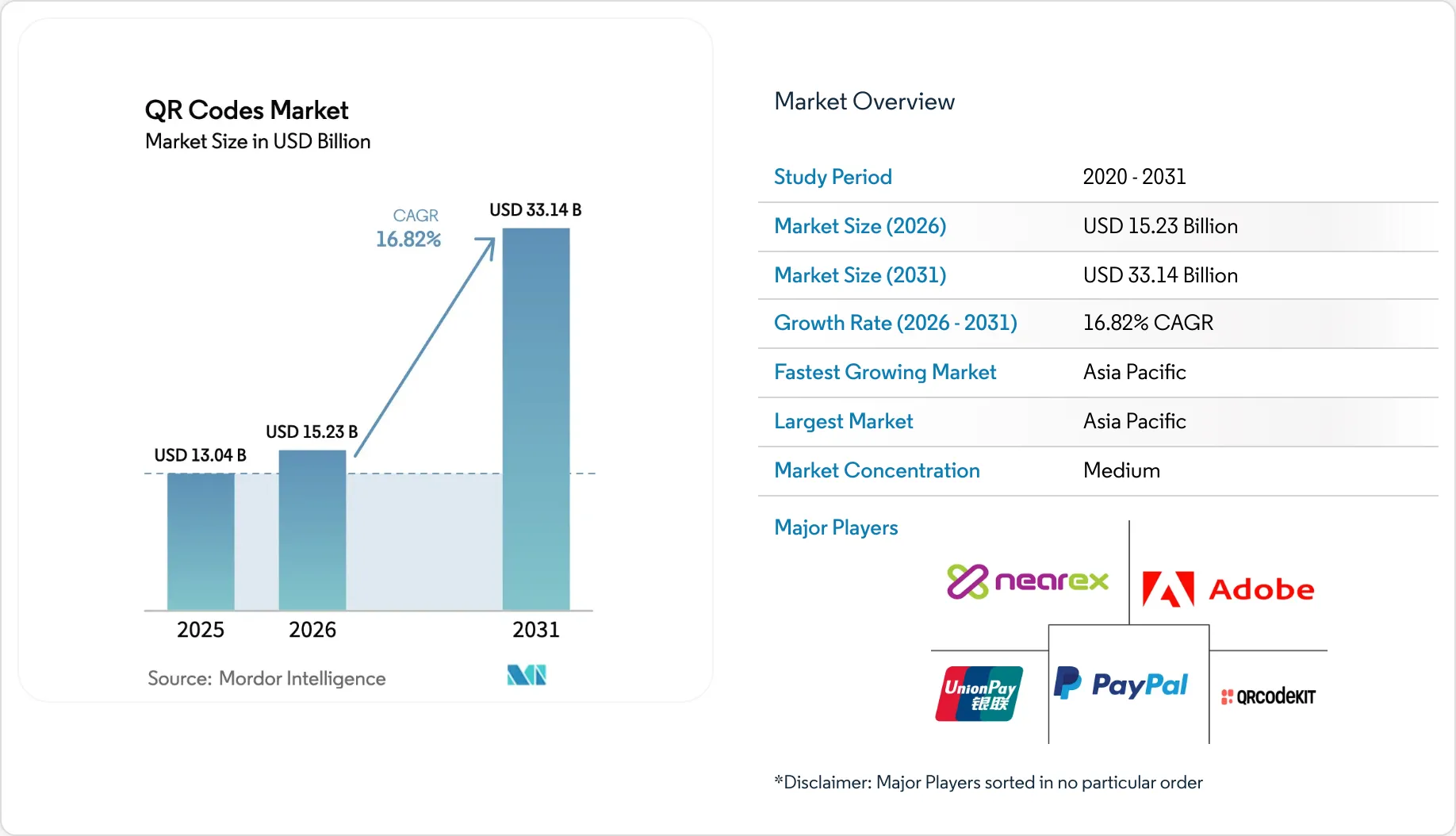
QR codes have become much more familiar to survey participants. Mordor Intelligence estimates the QR codes market at $15.23 billion in 2026, rising to $33.14 billion by 2031. That growth reflects a wider shift toward mobile-first access, contactless interactions, and fast digital engagement.
The main issue with QR codes is access control. A public survey link can reach a wider audience, but it can also reach the wrong people. If your goal is anonymous public feedback, an open link may be appropriate. If you need a representative sample, verified survey takers, or higher-quality data from a defined audience, then authenticated access is safer.
A practical rule: use anonymous links when the research is low risk and broad participation carries more value than identity verification. Use unique links, login controls, invitation lists, or access codes when data validity, confidentiality, or respondent eligibility shapes the outcome.
SMS surveys
SMS surveys are distributed by text message, usually with a short invitation and a link to the online survey. Some SMS surveys ask respondents to reply directly with a number or short answer, but most research teams use SMS to drive people to a mobile-friendly survey.
SMS works best for short surveys, time-sensitive feedback, appointment follow-ups, service updates, field research, and audiences who are more responsive on mobile devices than email. It can be especially effective when your target market is reachable by phone but less active through email or formal platforms.
Keep the survey short. Mobile screens, character limits, and attention span all shape what works. A long questionnaire sent by SMS can quickly create survey fatigue, while a short pulse survey can feel timely and easy.
Regulatory requirements are a major consideration. In the US, the Telephone Consumer Protection Act (TCPA) places consent requirements on certain text message outreach, including marketing-related robotexts. The Federal Communications Commission has also emphasized prior express written consent for covered robocalls and robotexts.
In the UK, Privacy and Electronic Communications Regulations (PECR) restrict unsolicited marketing by text and often require specific consent, especially for individual subscribers.
There are also privacy considerations beyond the survey platform itself. Text messages may pass through mobile carriers and appear in device notifications, which can be inappropriate for sensitive topics. For confidential research, SMS is often best used as a neutral invitation, with the survey questions and responses handled inside a secure survey environment.
Social media surveys
Social media surveys use posts, stories, groups, direct messages, paid ads, or profile links to direct people to a survey. They’re useful when your audience is active online and you want to reach a diverse audience quickly.
Social media platforms can be helpful when conducting brand awareness research, public opinion gathering, early concept testing, and low-sensitivity market research. They can also help market research agencies reach niche communities, provided the recruitment method is transparent and the sample limitations are clearly understood.
The downside is data quality. Social media distribution gives you limited control over who sees the survey, who responds, and whether respondents match the intended audience. Algorithms, self-selection bias, repeat participation, professional survey takers, and random device engagement can all affect data validity.
Social media works best for gathering directional signals rather than collecting data for high-stakes decisions. If you use social media, screen respondents carefully, monitor for duplicate responses, and avoid asking for unnecessary personal details.
In-app and in-product surveys
An in-app survey appears inside a digital product, often triggered by behavior. For example, a survey might appear after a user completes onboarding or reaches a milestone.
Instead of asking people to recall an experience days later, you gather feedback while the experience is still active, which can improve relevance and help product teams collect feedback from engaged users and active users.
In-app surveys are useful for UX research, product research, customer satisfaction, feature feedback, onboarding evaluation, and churn prevention. They work best when they’re short, well-timed, and clearly connected to what the user just did.
Security depends partly on the product’s infrastructure. Data may flow through the application, analytics tools, customer data platforms, and the survey platform. Teams should understand what data is captured automatically, where it’s stored, who can access it, and whether responses can be connected back to user profiles.
Paper and offline surveys
Paper and offline surveys still have a place. They’re used in fieldwork, healthcare, public sector research, academic studies, community engagement, and environments where digital access is limited. In-person interviews, phone interviews, telephone surveys, and paper forms can reach people who may be excluded by purely digital surveys.
Traditional methods are useful when personal interaction improves trust or when the research setting requires direct support. They can also help with accessibility, especially when survey participants need assistance or prefer not to use digital tools.
The drawback is speed and accuracy. Paper responses need to be digitized, and manual data entry can introduce transcription errors, delays, and extra cost. Offline data collection also raises storage and confidentiality questions. Completed forms may contain sensitive personal details, so teams need clear rules for transport, storage, scanning, retention, and disposal.
How to distribute a survey
Once you know the main distribution methods, the next question is: how do you move from a finished questionnaire to a survey that reaches the most relevant audience securely?
The how is inseparable from the why. Distributing surveys without a clear audience definition or access policy wastes effort and weakens data quality. A strong survey distribution strategy starts before the first invitation is sent.
Start by defining the target audience in plain language. Be specific about who should respond and who should not. For example:
- A customer survey may target existing customers who purchased in the last six months
- An employee survey may include all full-time staff in a certain region
- A research project may require a representative sample across age, location, role, or experience level
Next, choose the distribution channel based on audience behavior. Email surveys may work best for known users, while QR codes may work better at events, clinics, campuses, or retail locations.
You can then set access and authentication controls. Decide whether the survey should be anonymous, confidential, or identifiable. Choose whether respondents need a unique survey link, login, access code, single-use token, or open public link. The more sensitive the data, the more carefully you should control access.
After that, schedule or trigger distribution. When it comes to one-off studies, you may send invitations in waves and follow up with reminders. For ongoing programs, surveys may be distributed automatically after specific events, such as a purchase, support case, training session, appointment, or product milestone.
Finally, monitor response rates in real time. Look for uneven participation across segments, sudden spikes from one source, duplicate submissions, incomplete responses, or signs of survey fatigue. Effective survey distribution means adjusting the campaign as survey responses come in, not simply sending the survey and hoping for the best.
The best way to send a survey for your use case
The best way to send a survey is the method that balances reach, response rate, respondent experience, and the right level of data protection for what’s being asked.
A low-sensitivity brand awareness survey can use multiple channels, including social media, paid ads, QR codes, and open survey links. A confidential employee survey needs stronger access controls and clearer privacy communication. A healthcare, government, or enterprise research project may require authenticated access, audit trails, encryption, and data residency controls.
Security deserves attention from the start, especially considering the reputation and financial risks of data breaches. IBM’s 2025 Cost of a Data Breach Report put the global average cost of a data breach at $4.4 million, which highlights why survey data should be protected from the start rather than after a problem appears.
Here are the best distribution methods considering the level of data security you need.
For low-risk research, reach and convenience may carry the most weight, but for confidential or regulated research, the distribution method and the platform’s security architecture need to work together.
What’s the best way to distribute a survey securely
Secure survey distribution requires you to send surveys and collect data in a way that protects respondents, controls access, and preserves the integrity of the data.
The best way to distribute a survey securely is to use a method that combines encrypted transmission, respondent authentication where needed, role-based access controls, careful anonymity settings, audit trails, and compliance-ready data handling. The channel matters, but the survey platform behind the channel carries equal weight.
At a minimum, secure survey distribution should include:
- Encrypted transmission – Survey links, responses, and respondent data should be protected in transit
- Authentication options – Teams should be able to restrict access through unique links, login, SSO, access codes, or respondent lists
- Access controls – Only approved users should be able to view, export, edit, or manage survey results
- Anonymization where appropriate – Anonymous surveys should be configured so identities are not accidentally exposed through metadata or reporting
- Compliance alignment – The platform should support relevant obligations under GDPR and HIPAA information security practices, and other applicable frameworks
For GDPR, Article 32 highlights security measures such as pseudonymization, encryption, confidentiality, integrity, availability, resilience, and regular testing of technical and organizational controls.
For healthcare use cases in the US, the HIPAA Security Rule requires administrative, physical, and technical safeguards to protect electronic protected health information.
Simple feedback forms can often run on lightweight tools. Enterprise, government, medical, academic, and regulated-sector research usually needs stronger controls because respondents are trusting you with sensitive information.
Checkbox’s survey distribution and collection capabilities are built for teams that need to manage distribution across multiple channels while keeping control over survey participation, responses, and completion rates. Our goal is to help research teams collect data in a way that supports security, reliability, and trust.
For extra data security, you can choose one of our flexible hosting options, including region-specific surveys and on-premises deployment.
The right survey distribution method for your organization
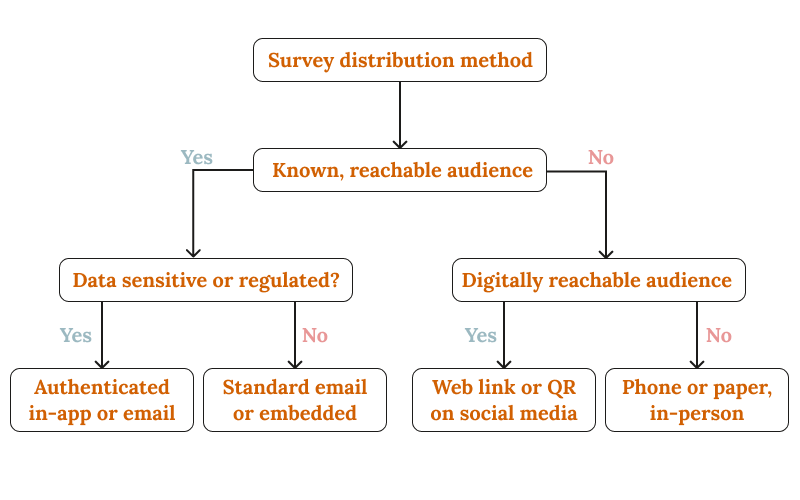
Choosing the right survey distribution method starts with a set of practical questions, the answers to which create a mental model for matching channel, audience, and risk:
- Who is the audience?
- What data do you need?
- What’s your ideal response rate?
- What regulations do you need to be compliant with?
- How can you scale and repeat your survey?
First, ask who the audience is and how they’re best reached. Existing customers may respond well to email, active users may be better reached through an in-app survey, and a community group may respond better through QR codes at an event.
A target market that’s active online may be reachable through social media platforms, while a less digitally connected audience may need phone surveys, paper forms, or in-person interviews.
Second, look at the data being collected. A simple survey asking about respondent preferences has a different risk from a questionnaire collecting health information, employee concerns, demographic details, or confidential research data.
The more sensitive the data, the more important it becomes to use authenticated access, encryption, clear consent language, and controlled reporting.
Third, define the survey response rate you need. If the research needs statistical confidence, you may need a sampling methodology and plan, reminders, multiple channels, and close monitoring by segment. If the goal is directional feedback, a smaller or less controlled sample may still provide useful insights.
Fourth, identify compliance obligations. GDPR, PIPEDA, HIPAA, internal security policies, data residency requirements, and procurement rules may all influence which distribution channel is acceptable. A method that works for a public brand survey may not pass review for clinical research or government data collection.
Fifth, consider scale. A one-off survey can be managed manually, but future surveys and ongoing programs need repeatable workflows, templates, automations, reporting, and governance. The distribution strategy should support today’s study without creating problems for tomorrow’s.
A good decision framework helps you decide whether to use one channel, multiple channels, or a phased approach based on the intended audience, sensitivity, and research goals.
Survey distribution best practices
The best survey methods can still fall short if the distribution experience feels unclear, intrusive, or poorly timed. Good survey distribution should encourage participation while respecting the respondent’s time and privacy.
1. Keep the survey as short as the research allows
Long surveys can reduce completion rates and increase survey fatigue, especially on mobile devices. If a survey must be long, tell participants what to expect and consider progress indicators, save-and-return options, or sectioning.
2. Personalize distribution where it’s appropriate
A recognizable sender, relevant subject line, and clear explanation can improve trust. Personalization should feel useful rather than invasive, especially when the survey asks sensitive questions.
3. Test every survey link before launch
Check access settings, authentication, mobile display, branching logic, embedded behavior, and completion pages. A broken link or incorrect permission setting can damage both response rates and confidence in the research.
4. Monitor for duplicate or fraudulent responses
Public links, social media surveys, paid ads, and QR codes can attract low-quality data if controls are weak. Use duplicate prevention, screening questions, time checks, IP rules where appropriate, and review patterns that suggest professional survey takers or automated responses.
5. Be clear about how data will be used
Tell respondents who is running the survey, why the data is being collected, whether answers are anonymous or confidential, and how long the data will be retained. Clear communication builds trust and can encourage participation.
6. Follow up carefully
Reminders can improve response rates, but over-contacting can annoy respondents and weaken future survey performance. Set a reasonable cadence and stop reminders once someone completes the survey.
Final thoughts
Survey distribution methods shape data quality, respondent trust, compliance risk, and the usefulness of the survey results.
Email surveys, embedded surveys, QR codes, SMS surveys, social media, in-app prompts, and offline solutions all have a place. The right survey distribution method depends on who you need to reach, what you’re asking, how sensitive the data is, and what level of control the research requires.
A strong approach starts with audience clarity, then matches the channel to the use case. From there, secure survey distribution should be built into the workflow through encryption, authentication, access controls, anonymization options, audit trails, and compliance-ready data handling.
If your current distribution strategy relies on convenience alone, it’s worth auditing it against the criteria in this guide. Ask whether each method reaches the right audience, protects respondent data, supports data validity, and gives your team the control it needs.
To see how Checkbox supports secure, flexible survey distribution and collection end-to-end, sign up for a free trial today.

Contact us
Fill out this form and our team will respond to connect.
If you are a current Checkbox customer in need of support, please email us at support@checkbox.com for assistance.
