
How to build a patient feedback system that’s secure by design
Patient feedback is integral to how patients evaluate care, how leadership teams identify service gaps, and how regulators expect healthcare organizations to demonstrate accountability.
In the US, the Hospital Consumer Assessment of Healthcare Providers and Systems (HCAHPS) survey gives hospitals a standardized, publicly reported way to measure patients’ perspectives of hospital care. CMS also states that hospitals subject to Inpatient Prospective Payment System payment provisions must collect and submit HCAHPS data to receive their full annual payment update.
That raises the stakes for any patient feedback system. It’s not enough to ask the right questions. You also need to know where patient data is stored, who can access it, how responses are routed, and whether the platform collecting that feedback can support your compliance obligations.
Patient feedback can look harmless at first: a comment about a discharge process, a rating of a ward, or a note about an appointment. Once that response is tied to personally identifiable data – a patient, visit date, condition, clinician, or contact record – it becomes protected health information under HIPAA or special category data under UK GDPR.
Under HIPAA, vendors that handle protected health information for covered entities may need written assurances through a business associate agreement, while under UK GDPR, special category data needs extra protection and an Article 9 processing condition before processing begins.
In this guide, you’ll learn what a patient feedback system is, why compliance is harder than it looks, what to look for in a patient feedback management system, and how to set up a process that captures useful patient insights without treating patient data like ordinary survey data.
What is a patient feedback system?
A patient feedback system is the combination of software, processes, and workflows your organization uses to collect, manage, analyze, and act on feedback from patients.
A paper card in a waiting room may collect feedback, but it won’t reliably route negative feedback to the right team, identify trends across sites, or give leadership the reporting needed to improve patient satisfaction over time.
A modern patient feedback system usually includes:
- Digital patient surveys sent by email, SMS, QR code, or embedded web form
- Real-time feedback collection after appointments, procedures, or discharge
- Reporting dashboards for patient satisfaction metrics and service trends
- Workflows that route patient concerns to the right clinical, administrative, or management teams
- Security controls that protect patient feedback data across collection, storage, and access
It also helps to separate one-off surveys from an ongoing patient feedback management system.
A one-off survey answers a narrow question, such as whether patients were satisfied with a new booking process. A feedback management system runs continuously. It helps healthcare professionals gather feedback at key points in the patient journey, monitor patient satisfaction levels over time, and close the feedback loop when a response needs follow-up.
For healthcare organizations, that management layer is where you can find the real value. Collecting patient responses is useful, but turning those responses into data-driven decisions, while protecting patient information, is what makes the system operationally credible.
Why patient data compliance is harder than it looks
The common mistake with patient feedback software is treating it like customer satisfaction software.
Healthcare feedback is different. A patient might mention a diagnosis in a free-text field. A survey invite might be triggered by a recent oncology appointment. A response might include a discharge date, a ward name, a clinician’s name, or a complaint about medication instructions. Each detail can change the risk profile of the data you’re collecting.
Under HIPAA, the issue is not only whether a survey asks clinical questions. It’s whether a vendor creates, receives, maintains, or transmits protected health information on behalf of a covered entity – i.e., an organization or individual that must follow HIPAA rules.
According to HHS, covered entities must obtain written assurances that a business associate will appropriately safeguard protected health information.
Under UK GDPR, health-related feedback can fall into special category data, which the ICO describes as personal data needing more protection because it’s sensitive. Organizations need both an Article 6 lawful basis and a separate Article 9 condition, and they must determine the condition before processing begins.
That’s why data residency is a governance question, not just an IT requirement.
Data residency means the physical location where data is stored, such as a country, data center, or cloud region. Data sovereignty goes further: it considers which laws and jurisdictions apply to that data. Essentially, residency is about where data sits, while sovereignty is about the legal control around it.
For healthcare providers in the UK, EU, Canada, Australia, and other regulated markets, those questions affect vendor selection. If a mainstream survey platform stores patient feedback data in a default cloud region outside your required jurisdiction, you may need additional contractual, technical, and legal controls before using it for patient feedback collection.
There’s also an increased risk to security when third parties enter the workflow.
HIPAA Journal’s 2026 healthcare breach statistics, based on HHS Office for Civil Rights data, show that hacking and IT incidents accounted for more than 80% of large healthcare data breaches visible in the breach portal for 2025.
The same report also notes that healthcare data breaches include incidents involving covered entities and business associates.
Anyone building a secure patient feedback system must start there. Before you design questions or set up real-time feedback triggers, you need to know where responses will live, which vendor contracts apply, who can access the data, and how the platform supports compliance review.
Checkbox is built for organizations that need that level of control.

Healthcare and pharmaceutical organizations can deploy HIPAA-compliant surveys using on-premises deployment and keep patient data within their own infrastructure. Customers can choose between flexible hosting options in the United States, Canada, Europe, Australia, or their own data center.
What to look for in a patient feedback management system
A patient feedback management system should make it simple to collect feedback, but ease of use should never come before data governance.
For healthcare providers, security and compliance features are not premium extras. They are baseline requirements. Start there, then evaluate survey design, analytics, and reporting.
Look for these capabilities:
- Data residency and sovereignty options. You should be able to choose where patient feedback data is stored, or keep it inside your own infrastructure when required.
- BAA or DPA availability. If HIPAA, GDPR, PIPEDA, or other privacy regulations apply, confirm whether the vendor can support the right agreement before any patient data is collected.
- Role-based access controls. Clinical teams, administrators, researchers, and executives should not all see the same level of patient feedback information.
- Audit trails and reporting controls. You need accountability for who accessed feedback data, who changed settings, and how reports were shared.
- Configurable workflows. Negative feedback, urgent patient concerns, and service-specific comments should route to the right team quickly.
- Integration options. A good system should fit alongside clinical, patient management, analytics, or electronic health records workflows without creating uncontrolled data movement.
- Secure distribution channels. Email, SMS, web links, and QR codes are all useful, but each channel needs privacy-aware configuration.
Collecting the right patient feedback data, protecting it properly, and making sure the organization can act on it are all integral parts of effective patient experience management.
How to set up an effective patient feedback system
Setting up an effective patient feedback system means working in the right order. Many healthcare organizations start with survey questions. A better approach is to start with measurement goals, compliance requirements, and operational workflows.
Define what you want to measure
Before choosing feedback software or writing patient surveys, define what the feedback program needs to achieve.
Do you:
- Need to meet a regulatory or accreditation requirement?
- Want to measure patient satisfaction after discharge?
- Want to improve patient communication in one service line?
- Need to reduce complaints about scheduling?
- Want to understand patient preferences for follow-up care?
Your goal shapes the whole system.
For example, if your priority is improving discharge communication, you’ll need questions that measure whether patients understood their medication instructions, warning signs, and next steps. If your priority is overall patient satisfaction, you’ll need broader patient satisfaction metrics across the patient journey.
Established frameworks can help. The Picker Principles of Person Centred Care cover areas such as access, continuity of care, clear information, involvement in decisions, emotional support, and respect for preferences.
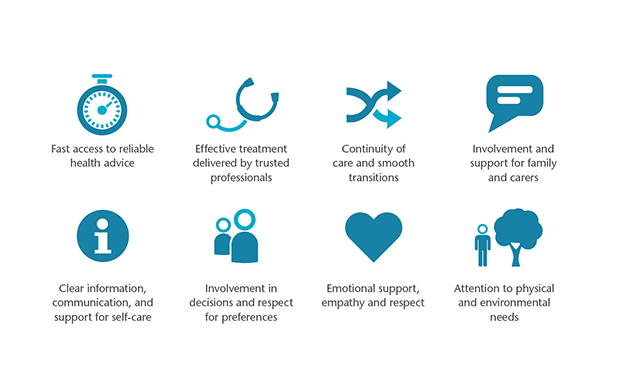
These principles are used as a framework for understanding what matters most to people receiving care.
Confirm your compliance requirements before you build
This is the step many healthcare organizations skip.
Before building the survey, confirm which regulations apply to your healthcare practice or organization. That may include HIPAA in the US, UK GDPR or EU GDPR, PIPEDA in Canada, the Australian Privacy Act, or sector-specific rules for clinical research.
Then ask practical vendor questions:
- Will the vendor sign the required BAA, DPA, or equivalent agreement?
- Where is patient data stored by default?
- Can data residency be configured?
- Can data be self-hosted or kept on-premises?
- Who inside the vendor can access survey responses?
- Does the platform support access controls, auditability, encryption, and secure integrations?
Do this before collecting a single patient response. Retrofitting compliance after feedback data has already moved through the wrong system is slower, riskier, and harder to explain during an audit.
Choose your survey format and questions
Not every patient feedback survey needs to be long.
A short post-visit pulse survey works well when you need real-time patient feedback about a specific interaction. A longer experience survey is better when you need to understand a full episode of care, such as admission through discharge.
Good patient feedback questions focus on specific, observable experiences. Vague satisfaction questions can help measure overall satisfaction, but they rarely tell teams what to fix.
For example, instead of only asking “How satisfied were you with your care?”, ask about concrete moments:
- How clearly did your care team explain the next steps?
- Were you able to get help when you needed it?
- Did you know who to contact after leaving the clinic or hospital?
- Were your preferences considered during your appointment?
- Was the environment clean, private, and accessible?
Branching logic can help keep customizable surveys short without losing detail. If a patient reports a poor experience, follow-up questions can ask what happened, or if they report a positive experience, the survey can ask what worked well.
Set up real-time collection triggers
A real-time patient feedback system collects feedback while the experience is still fresh.
Common trigger points include:
- After an outpatient appointment
- After a procedure
- After discharge
- After a telehealth visit
- After a support call or administrative interaction
The channel should match the patient communication context:
- SMS can work well for short post-visit surveys
- Email may be better for longer feedback surveys
- QR codes can be useful at the point of care, especially when you don’t want to move contact data into a third-party campaign tool
Automation is useful, but it raises the same compliance questions as the survey itself. If patient contact data moves from an appointment system into patient survey software, that workflow needs the same privacy review as the feedback data.
Route responses and close the loop
A feedback system that only collects data will lose value quickly.
Patients share feedback because they expect healthcare providers to listen. Leadership teams need trend data, but frontline teams also need timely alerts when feedback points to an immediate issue.
A strong feedback loop includes:
- Real-time routing for negative feedback or urgent patient concerns
- Clear ownership for each type of response
- Regular reporting cadences for clinical, operational, and management teams
- Trend analysis by service line, location, care pathway, or patient group
- Visible changes that show patients their feedback influenced patient care
With a feedback loop in place, a patient feedback management system becomes more than survey software; it becomes part of operational efficiency, patient engagement, and quality improvement.
Questions to include in a patient feedback survey
Good patient feedback questions are specific enough to create actionable insights and respectful enough not to overwhelm patients.
HCAHPS gives one useful model.
It’s a standardized survey for measuring patients’ perceptions of hospital care, covering areas such as communication with nurses and doctors, responsiveness of hospital staff, discharge information, cleanliness, quietness, overall rating, and willingness to recommend.
The NHS Friends and Family Test gives another model: a short question about whether someone would recommend the service, with space to explain the answer. FFT results are published monthly and can be analyzed by organization, site, and ward level.
The common thread is specificity. Useful questions focus on patient perspectives around things the organization can observe, analyze, and improve.
Strong patient feedback questions often cover:
- Access to appointments and services
- Clarity of patient communication
- Respect, empathy, and involvement in decisions
- Cleanliness, comfort, privacy, and accessibility
- Discharge instructions and follow-up support
- Confidence in the care received
- Barriers that made the patient journey harder
- Positive feedback about what should be repeated
Free-text questions are also valuable. Positive and negative feedback in a patient’s own words can reveal issues that structured patient satisfaction surveys miss. The key is to manage those responses carefully, because open-text fields are also where patients can enter sensitive health information.
Final thoughts
A patient feedback system is only as good as the trust behind it.
- Patients need to trust that their feedback will be heard and handled responsibly
- Healthcare professionals need to trust that patient feedback data is accurate, timely, and useful
- Regulators need to trust that the organization collecting feedback has appropriate safeguards in place
That trust depends on more than survey design. It depends on data residency, access controls, vendor agreements, secure distribution, and workflows that turn patient insights into better patient care.
Checkbox is a strong fit for healthcare organizations that need more than a generic feedback tool. With flexible hosting, on-premises deployment options, healthcare-focused survey workflows, role-based access, real-time insights, and secure distribution channels, Checkbox helps you collect valuable feedback while keeping patient data under the level of control healthcare demands.
Start a free Checkbox trial today or watch our short demo.
Patient feedback system FAQs



Contact us
Fill out this form and our team will respond to connect.
If you are a current Checkbox customer in need of support, please email us at support@checkbox.com for assistance.
