
The complete guide to customer feedback: Meaning, methods, and action
Customer feedback sits at the center of almost every modern growth, retention, and customer experience conversation. Nearly every business says it wants to hear from customers. The best businesses put desire into action with well-designed customer feedback surveys and build a process that turns feedback received into better decisions, better follow-up, and better experiences.
Instigating and running this process shows customers that your brand is genuinely listening. In its Global State of Customer Service report, Microsoft found that 89% of respondents said organizations should give them the opportunity to provide feedback, but only 47% believe most brands take action on customer feedback.
That mismatch suggests that collecting and utilizing customer feedback effectively is vital for a business that wants to resonate with its customers. A strong customer feedback strategy treats gathering feedback as the starting point, not the finish line.
In practice, that means understanding the meaning of customer feedback, choosing the right feedback channels, analyzing customer feedback carefully, and building a customer feedback loop that leads to action. To get there, let's start with a clear definition.
What is customer feedback?
Customer feedback is the information people share about their experience with a product or service.
That information can reveal how satisfied they are, where friction appears in the customer journey, what customer needs are going unmet, and what changes would improve the experience.
Feedback from customers can be direct and explicit, such as a post-purchase survey response, or indirect and behavioral, such as a review, a cancellation reason, or repeated complaints about the same workflow.
A useful way to understand customer feedback is to separate proactive collection from passive customer feedback. Solicited feedback is what you ask for. It includes:
- Feedback requests sent through email surveys
- Post-call forms
- Customer interviews
- Focus groups
- In-app surveys
- Structured feedback forms
Unsolicited feedback is what customers provide without being asked in a formal way. It shows up in:
- Online reviews
- Support tickets
- Churn comments
- Social media comments
- App store ratings
- Sales feedback shared during a renewal conversation
Each tells you something slightly different. Solicited collection helps you measure customer satisfaction consistently. Unsolicited feedback often captures urgency, emotion, and real-world context.
Here's an example of both in action. Imagine a software company launches a new onboarding flow. It might collect customer feedback through a short CSAT survey after setup is complete. That gives it structured, comparable data.
At the same time, the support team may notice an increase in tickets from unhappy customers who cannot find a required setting. Those tickets are also feedback. So are negative feedback comments in a review platform and social media mentions about a confusing first-use experience. Each source reflects the same problem from a different angle.
Alternatively, a customer might rate a support interaction 5 out of 5, but then leave an open-text comment saying the agent was helpful even though the issue took three attempts to fix. The score tells you the interaction felt positive. The detailed feedback tells you the underlying process still needs work.
Customer opinions become more valuable when teams look past the headline number.
Why customer feedback matters
In Microsoft's State of Global Customer Service report, 90% said that customer service is important to their choice of and loyalty to a brand. In other words, asking for customer input is not a soft gesture. It influences how people evaluate whether a business is worth staying with.
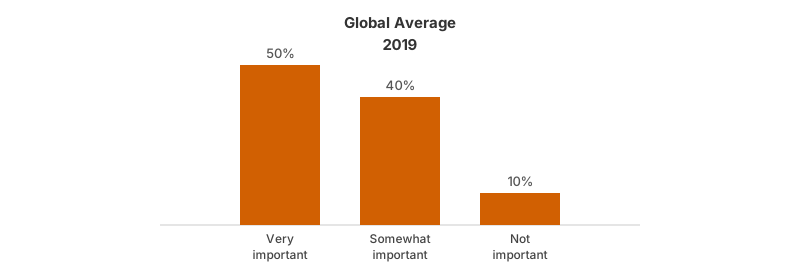
Feedback also helps you catch friction before it becomes churn. Microsoft found that 58% have stopped doing business with a brand because of a poor customer service experience. Customers usually tell you where the frustration is before quarterly retention numbers explain the cost of ignoring it.
It's important to understand that frustration occurs at every stage of the customer journey. During acquisition, customer feedback examples can tell you what buyers find confusing in your pricing, messaging, or demo process.
During onboarding, feedback can surface whether customers understand the value of your product or service.
During ongoing usage, feedback data can expose usability issues, missing integrations, feature requests, or repeated support pain points. During renewal, the same process can reveal whether customers feel supported, successful, and likely to stay.
There's also a cultural reason customer feedback matters. When teams regularly ask for customer feedback and review it together, they make better decisions. Product teams get closer to customer behavior rather than relying on internal assumptions. Marketing teams sharpen positioning around real customer pain points. Customer success teams get a clearer view of what puts accounts at risk. Leadership gets a more grounded picture of what drives customer loyalty and business growth.
A well-run customer feedback program does not just help you fix problems. It helps you identify trends, prioritize investments, and turn customer insights into action. Mature teams don't rely on one score or one channel; they build a mix of feedback types that work together.
Types of customer feedback
A strong customer feedback program blends several forms of feedback, as every source has strengths and weaknesses.
Solicited feedback
Solicited feedback is the information you actively request.
Common examples:
- Customer surveys
- Interviews
- Focus groups
- In-product prompts
- Post-interaction forms
Strengths and weaknesses
Solicited feedback is useful when you want consistent inputs, benchmarkable scores, or answers to specific questions. Its weakness is that it reflects the questions you chose to ask. Poor survey design can limit what you learn.
Unsolicited feedback
Unsolicited feedback is what customers share on their own.
Common examples:
- Online reviews
- Support tickets
- Social media mentions
- Churn reasons
- Community posts
- Comments passed on by a sales or customer success team.
Strengths and weaknesses
Unsolicited feedback tends to be candid and emotionally honest, which makes it valuable. Its weakness is inconsistency. Without a system to collect feedback from those channels in one place, patterns are easy to miss.
Quantitative feedback
Quantitative feedback is structured and countable.
Common examples:
- Ratings
- Rankings
- Scores, such as NPS, CSAT, and CES
- Closed-ended survey responses
Strengths and weaknesses
Quantitative data helps you measure customer satisfaction over time, compare segments, and spot movement quickly. Its weakness is that it tells you what happened more easily than why it happened.
Qualitative feedback
Qualitative feedback adds the missing context.
Common examples:
- Open-ended survey responses
- Interview transcripts
- Review text
- Live chat comments
- Complaint details
- Free-form observations from customer support interactions
Strengths and weaknesses
Qualitative feedback is where you get emotion, nuance, and specificity in your responses. It is often the difference between knowing satisfaction declined and understanding which part of the experience caused it. The tradeoff is speed. Qualitative analysis takes more effort, especially without a clear tagging system.
Here's a table running through those different types again:
The most useful customer feedback system combines those layers. You might use a survey to measure satisfaction at scale, interviews to understand the reasoning behind the scores, and social media monitoring to spot emerging issues in real time.
There are also specific, named customer feedback mechanisms that businesses use to understand their relationships with customers: NPS, CSAT, and CES.
Net Promoter Score (NPS)
Net Promoter Score measures customer loyalty by asking how likely someone is to recommend your company, product, or service.
Respondents answer on a 0 to 10 scale and are grouped into Promoters (9–10), Passives (7–8), and Detractors (0–6). NPS is popular because it is simple, easy to benchmark internally, and useful as a high-level signal of relationship health.
Its biggest limitation is also its simplicity. A number alone does not tell you why customers gave that score. Used well, NPS should be paired with an open-ended follow-up question and analyzed alongside account context, segment data, and product usage. Used badly, it becomes a vanity metric that looks strategic but says little about specific improvements.
Customer Satisfaction Score (CSAT)
Customer Satisfaction Score measures a user's satisfaction with a particular interaction or experience. You usually send it immediately after a support exchange, purchase, onboarding step, or other defined moment. CSAT is especially useful for measuring customer happiness at specific touchpoints and for tracking operational performance in customer service interactions.
CSAT works best when timing and context are tight. A post-interaction survey after a support resolution can tell you whether the customer felt helped. A post-delivery survey can tell you whether fulfillment met expectations. What it cannot do on its own is explain broader customer loyalty.
CSAT is excellent for diagnosing parts of the journey, but weaker as a standalone view of the whole relationship.
Customer Effort Score (CES)
Customer Effort Score measures how easy it was for a customer to complete a task or resolve an issue. It's usually tied to moments such as contacting support, changing account settings, finding information, or finishing a purchase. Put simply, CES asks whether the business made the experience easy or made the customer work for it.
Effort is often what customers remember most clearly in service experiences. When the process is confusing, repetitive, or slow, loyalty erodes even if the final answer is technically correct. Low-effort experiences tend to support retention because they reduce frustration before it hardens into negative feedback or customer churn.
Understanding the types of customer feedback is one thing. Designing the right way to gather customer input is where the program becomes practical.
How to collect feedback from customers
Once you know which forms of feedback matter, the next question is how to collect feedback from customers in a way that fits the moment.
The method should match the context. A one-question pop-up in the middle of a workflow captures a different kind of signal than a follow-up email a day after a support interaction.
Good collection is not about asking everywhere; it's about asking in the right place, at the right time, with the right level of effort.
The mistake to avoid is creating a feedback black hole.
Teams make the error of gathering customer feedback across email, product, support, reviews, and social media, but store it in separate tools or separate team workflows. Make sure you keep feedback in a single centralized place so it does not disappear into scattered spreadsheets, inboxes, and backlogs.
The main collection methods usually include email surveys, in-app surveys, post-interaction surveys, customer interviews, review platforms, and social listening.
Email works well when you want thoughtful answers after a purchase, the onboarding phase, or a customer success milestone. In-app surveys are best when you need feedback close to the experience itself. Post-interaction surveys are ideal for measuring customer satisfaction after customer support interactions. Review platforms and social media monitoring are essential for unsolicited feedback because they surface what customers say when they are not responding to a company-designed questionnaire.
A useful collection strategy also respects customer attention. Too many feedback requests create survey fatigue. Too few requests leave blind spots. The goal should always be actionable customer feedback collected with enough regularity to reveal patterns.
Surveys and questionnaires
Surveys and questionnaires remain the most scalable way to gather customer feedback. They are especially effective when you need structured, quantitative data, clear segmentation, and repeatable reporting. A good survey helps you measure customer satisfaction across touchpoints, compare groups, and track trendlines without turning every insight request into a manual research project.
Survey quality depends more on design than length. Here are some survey design tips to keep in mind:
- Keep questions focused on one topic at a time
- Avoid leading language
- Tell people how long the survey will take
- Respect the difference between what you want to know and what a customer can reasonably answer
A tight five-question feedback survey will usually outperform a vague twenty-question form because it produces cleaner feedback data and higher completion rates.
It also helps to balance closed-ended and open-ended questions. Closed-ended questions give you quantitative data you can benchmark. Open-ended prompts give you direct feedback in the customer's own language. If you ask only for ratings, you miss context. If you ask only open questions, analysis becomes slower and messier. Well-designed customer feedback surveys use both.
Customer interviews
Surveys are efficient, but interviews can help you get more nuance and depth in your answers.
A customer interview lets you understand why a person answered the way they did, what emotion sat behind the answer, and what else was happening around the experience.
Interviews are especially valuable when you are exploring churn, testing a new feature direction, refining onboarding, or trying to understand why unhappy customers are not getting value from the product.
They're also useful when the business needs more than surface-level customer opinions. A customer might say onboarding felt hard in a survey. In an interview, you may learn that the issue was not the setup at all. In fact, it was unclear ownership on the customer side, poor internal handoff, or a reporting gap that made early wins hard to prove. That kind of insight is hard to capture in a rating scale.
You don't need hundreds of interviews to learn something important. Even a small set of well-run conversations can shift how a team understands a problem. The key is consistency – use a discussion guide, look for repeated themes, and connect what you hear back to broader feedback channels rather than treating each interview as a standalone anecdote.
Reviews and social listening
Reviews and social listening capture unsolicited feedback in public or semi-public settings.
Customers often say different things when they aren't speaking through a company-owned survey. Review sites, Google reviews, app stores, community threads, and social media channels all reveal what people feel strongly enough to share without a prompt.
Those channels can be messy, but they are rich. Positive feedback shows what customers value and what language they naturally use to describe it. Negative feedback highlights customer pain points, gaps in customer support interactions, and moments where expectations were not met. Repeated social media comments or repeated complaints in reviews often provide valuable insights into issues that structured surveys have not yet captured.
Speed matters here. Responding to negative reviews promptly signals that the business takes accountability seriously. The same applies to social media mentions that raise real issues. Customers don't expect perfection, but they do expect acknowledgment, clarity, and some sign that the company will do something with the feedback received.
Once customer feedback is flowing through the right methods, the challenge shifts from collection to interpretation.
How to analyze customer feedback
Collecting feedback is relatively easy. Analyzing customer feedback is often the challenging part.
Once responses start arriving from customer surveys, interviews, support tickets, online reviews, and social media, you need to organize what you have into something your team can act on. Having a centralized location for your data and creating clear systems to categorize and prioritize it is key.
Start by tagging feedback by theme. Common categories might include onboarding, billing, usability, feature requests, customer service, reporting, pricing, and integrations. Then add useful context such as segment, account type, touchpoint, sentiment, and source.
That process helps separate signal from noise. One loud complaint may matter, but fifty comments across different channels about the same problem matter more. Use categories that make sense across teams, not only within one department, so that product, support, marketing, and leadership can all read the same picture.
The next step is prioritization. Not all feedback is equally urgent. Cosmetic suggestions should not outrank issues that block adoption, create churn risk, or repeatedly frustrate loyal customers.
Not every mention is of equal importance. Instead, the priority should always be understanding impact. Ask questions like:
- How many customers mentioned the issue?
- Which customers mentioned it?
- At what point in the customer journey did it happen?
- Does it affect customer retention, revenue, trust, or customer success?
Qualitative synthesis is also important. Ten people may mention "reporting," but they mean three different things: they cannot find a report, they do not trust the data, or they cannot export it in the right format. Those are different problems with different solutions, which is why qualitative feedback deserves serious attention rather than being reduced to a word cloud.
The timing of feedback is also an important consideration during analysis. Rising ticket volume and worsening resolution times usually confirm that something has already gone wrong. Customer comments often surface the problem earlier, while support queues can be streams of useful customer insights when you treat them as more than issue disposal systems.
Analysis only matters if it changes what the organization does next, which is where closing the feedback loop comes in.
Closing the feedback loop
Closing the feedback loop is the part many teams skip, even though it's where trust is built.
Closing the loop means taking action on what customers told you and then making sure the right people know something changed. Medallia found that only 48% of companies close the loop with dissatisfied customers.
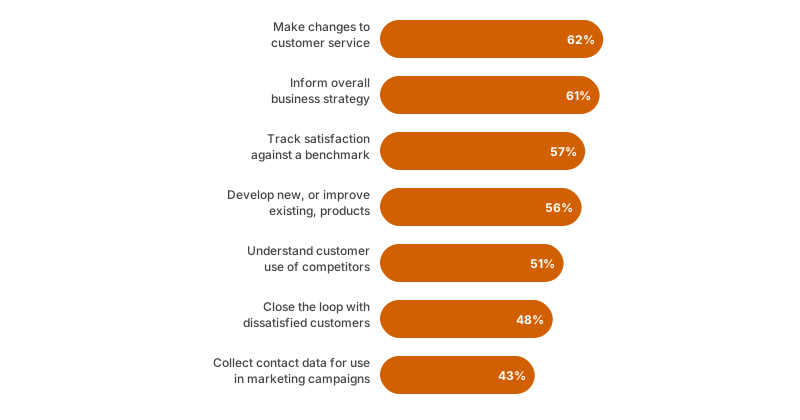
There are really two loops to close. The internal loop sends insights to the teams that can fix the issue. The external loop communicates back to the customer who raised it. You need both. If the product team never sees recurring complaints, nothing improves. If the customer never hears what happened, the business still looks unresponsive.
Sharing feedback internally
Internal sharing is where actionable feedback becomes cross-functional insight.
- Product teams need a view of feature requests, usability friction, and workflow blockers.
- Support teams need recurring complaint themes and post-resolution sentiment.
- Marketing needs customer language, objections, and proof points.
- Leadership needs a summary of what is most urgent, most repeated, and most tied to retention or growth.
Customer success managers often sit at the center of this process because they hear recurring frustration before it appears anywhere else. They know which customers are confused, which accounts are at risk, and which product gaps repeatedly come up in renewal conversations. When CSMs, support leads, and product owners share customer feedback on a regular cadence, patterns become visible much faster.
That sharing needs structure. A weekly digest, monthly insight review, or tagged Slack channel can work – what matters is that the feedback process produces a usable output, not just a pile of comments.
Acting on feedback and following up with customers
The external loop is simpler than many teams think. If a customer submits negative feedback after a poor service interaction, follow up. Acknowledge what happened, explain what you are doing next, and make it clear that their feedback was reviewed by a real person.
If a customer requested a feature and that feature later ships, tell them. If a recurring process issue gets fixed, let affected customers know.
That follow-up does more than resolve a single moment. It changes how customers perceive the relationship. Even when the business cannot act on every suggestion, a thoughtful response builds credibility. Silence does the opposite. It teaches customers that it is not worth taking the time to provide feedback next time.
Common mistakes in customer feedback programs
The same patterns show up again and again in weak feedback programs, and most of them are avoidable. They usually come down to process, ownership, and prioritization rather than intent.
The most common mistakes look like this:
- Collecting without acting. A company asks customers to submit feedback, then never changes anything or never explains what happened next. That is how trust erodes.
- Surveying too often. Too many feedback requests create fatigue, lower response quality, and make customers less willing to engage when the survey actually matters.
- Failing to centralize data. When reviews, support notes, social media comments, and survey responses live in different places, nobody can identify trends with confidence.
- Keeping insights inside one team. Support may see the issue, but product never hears it. Sales may hear objections, but marketing never adjusts positioning. Valuable feedback gets trapped in silos.
- Treating all feedback as equally urgent. A minor preference from one user is not the same as a repeated blocker affecting adoption, service quality, or retention.
- Relying on a single metric. One NPS score or one CSAT number cannot carry the weight of an entire customer feedback strategy.
Avoiding those traps sets up the final question: what does good look like in practice?
Customer feedback best practices
Strong teams treat customer feedback as an operating rhythm, not a side project. They know who owns the process, how feedback channels connect, and what happens after feedback is collected.
In practice, the best customer feedback programs usually follow these habits:
- Define ownership clearly. Someone should own the overall feedback system, even if multiple teams collect feedback.
- Ask the right question at the right time. Match the method to the moment. Use post-interaction CSAT for service touchpoints, interviews for exploration, and passive channels for unprompted sentiment.
- Combine quantitative and qualitative inputs. Scores help you measure. Comments help you understand.
- Set expectations with customers. Tell people how their feedback will be used, where they can submit feedback, and when they might hear back.
- Review on a fixed cadence. Weekly, monthly, or quarterly is fine. Waiting until a crisis usually means you are already behind.
- Prioritize for business and customer impact. Focus first on issues that affect customer experience, customer loyalty, adoption, and customer retention.
- Close the loop visibly. Share customer feedback internally, then communicate externally when action is taken.
Those habits turn gathering feedback into a repeatable feedback loop that produces actionable insights rather than more noise.
Final thoughts
Customer feedback is valuable because it can change what your business does next.
That's the thread running through every part of a good program. You collect customer feedback through the right channels. You analyze customer feedback carefully enough to understand the signal, you share it with the people who can act on it, and then you close the loop with customers so they can see their input mattered.
Structured, well-designed surveys sit at the heart of that process because they make it possible to gather consistent, reliable feedback at scale without losing sight of the people behind the responses.
Checkbox makes that work much easier. If you want to build branded customer feedback surveys, distribute them across the right touchpoints, and turn raw customer input into useful, actionable insights, Checkbox is built for exactly that kind of work. Request a Checkbox demo to see how we can help you gather customer feedback today.


Contact us
Fill out this form and our team will respond to connect.
If you are a current Checkbox customer in need of support, please email us at support@checkbox.com for assistance.
